See a set of the Daintette vaginal douche,
with pamphlets, etc., 1928-29?, U.S.A.
"Faultless
Feminine
Syringe," No. 240, made by the
Faultless Rubber Company, Ashland, Ohio,
U.S.A., perhaps from the 1960s or 1970s.


|

Portable bidet (Paris, France, 1928)
A bidet has allowed men and
women since possibly the Crusades
(11th to the 13th centuries) to
wash feet, hair, beards, genitals
and perineum. The bather usually rides it
like a pony; pony is what the
word meant in the French
of 400 or so years ago.
|
|
|
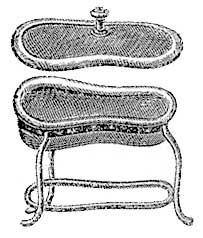
After taking off
the lid, you can see how you would
ride this bidet, at left, in the 1911
German guide for housewives Die
Frau als Hausärztin (The
Woman as Home Physician) by A.
Fischer-Dückelman. Here's
what the author says about washing
during menstruation (my
translation):
Every woman
should be able to wash her
genitals and the neighboring
region with lukewarm water in
order to get rid of adhering
blood, which decomposes
quickly, and unpleasant
secretions.
The best way to do this is
over a bidet by sitting with
more or less separated legs
and throwing water onto the
genitals.
|
|
|
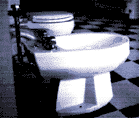
A bidet of today
- left,
with a toilet in the background,
from the interesting site The
Virtual
Baguette, which apprently no
longer deals with bidets - is made
of porcelain, mounted in a
bathroom next to a toilet, and
features a jet of water squirting
the genitals and between the
buttocks. Although I believe the
French have been the main users of
the bidet, today one can buy them
for bathrooms in at least North
America and Europe, although
American bidets are often devices
mounted on toilets, removed after
use.
|
The
beautiful bidet featured here,
below,
seems to be made of oak, heavy
enough to withstand water and
usage, and metal painted a gold
color. There are no fancy jets of
water; the user poured water over
her genitals - the old-fashioned
way.
The donor (see below) said it
belonged to her French mother, who
bought it in Paris in 1928.
Although heavy (about 31 pounds,
about 14 kilos), it is portable,
and collapses into a flat box-like
form (second picture, below). I
suspect the original owner, her
mother, a wealthy woman from Nice,
would have had servants carry it;
it was a lot for your MUM to carry
on the subway.
A metal plate under the right
"wing" (see the wing here)
reads
Siege - MATHIEU
B[?] S.G.D.G
DIPLôME D'HONNEUR
10, Rue Lacuée PARIS
[Mr. F. Reisner, of Bad Homburg,
Germany, publisher of The German
Plumbing & Sanitaryware
Suppliers Guide, e-mailed the
museum in November 2000,
translating the plate as follows:
Bté.
SGDG means "patented."
Breveté Sans Garantie du
Gouvernement means "Patented
without State Guarantee." Name
of the street in Paris is wrong
(probably difficult to read).
Diplôme d'Honneur means
that the inventor has received
some distinction, for instance,
at the occasion of a World Fair
or Inventors' Fairs (the most
famous French Inventors Fair is
called "Concours Lépine"
- Lépine was in the last
century a prefecture of Paris).
A woman born in France, living in
the Washington, D.C., U.S.A.,
area, generously donated it to
this museum in September of 1999
after having read about MUM in the
Washington
Post newspaper in 1995.
Because of the war, she barely
escaped France in 1939 with her
mother and sister, leaving
everything behind with friends and
neighbors. After the war, she
visited France to retrieve as many
of the family's possessions as she
could; some folks didn't want to
give them to her, but she rescued
the bidet, among other things.
After visiting this gentlelady,
I took the bidet home on the
subway, but not until after the
donor insisted on wrapping it up
in a black plastic garbage bag to
protect it from the eyes of my
fellow passengers. But I doubt
they would have guessed what it
was - I would have been glad to
tell them had they asked, and
start a general discussion in the
car - since bidets are uncommon in
America, but widely known to
flourish in France.
And Americans have that divided
attitude about France: she's (a
telling pronoun) the source of
taste and style, which we Puritans
can somewhat accept, and the pit
of naughtiness - a duality
wonderfully exemplified by the
bidet you see below.
|
|
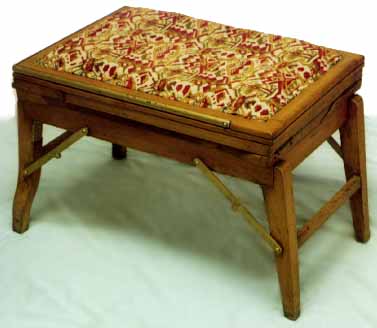
With legs extended,
the folded-up bidet looks like a
piano bench and is just slightly
smaller. This may have helped the
traveling woman conceal it from
visitors to her room, or simply
made it look nice to the woman who
could afford it - or both. Or
something else.
(All photos by MUM director
Harry Finley)
|
|
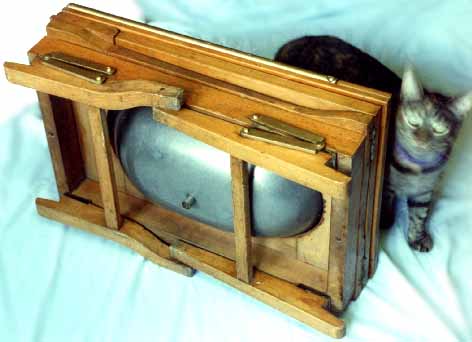
MEDS
(also the name of the first Modess
tampon), at right, is one of
a litter
of five interns at the
museum. (Can the Smithsonian claim
a litter of interns?) She is about
to inspect the underside of the
bidet, facing us, but, always the
professional, she awaits a
"go-ahead" sign from the
photographer, the MUM director,
before sniffing. Yeah, right.
(Meds died of lymphoma in 2006.)
Notice the drain
extending from the basin, the
cylindrical, bluish object in the
center (the metal is actually
silver gray). I wonder if a
drainage hose attached to it.
|
© 1999 Harry Finley. It is illegal to
reproduce or distribute
work on this Web site in any manner or
medium without
written permission of the author. Please
report suspected
violations to hfinley@mum.org
|