Other amazing women:
Dr. Grace Feder Thompson,
Nellie Bly,
Lydia Pinkham
Historical
remedies for menstrual period pain and
problems. See more remedies here.


|
Dr. Marie Stopes: An amazing woman in the
fields of birth control marriage relations
Her book, first published in 1918:
Married Love
by Marie Carmichael Stopes, D.Sc., London;
Ph.D., Munich
Fellow of University College London;
Fellow of the Royal Society of Literature
and of the Linnean
and Geological Societies, London. First
published in 1918 and, by 1931, translated
into 10 languages.
This first American edition was published
in 1931 by G.P. Putnam's Sons, New York
(The Knickerbocker Press)
"In my first marriage I
paid such a terrible price for
sex-ignorance that I feel that
knowledge gained at such a
cost should be placed at the
service of humanity."
from the Author's Preface to
the First English Edition (1918)
of Married Love
Readers of
the Guardian newspaper, in the
United Kingdom, voted Dr. Stopes
"Woman of the Millennium."
The amazing Scotswoman Dr. Marie
Stopes, founder of the first birth
control clinic in the British
Empire (The Mothers'
Clinic in London, still running),
in 1921, wrote this
ground-breaking book that devoted
a chapter to the cyclic nature of
women's sexual desire, a first,
part of which appears below.
In 1914 she had her
never-consummated first marriage
annulled after a year and began
work on this first-of-a-kind book
for Britain about sex to prevent
other humiliating marriages. She
later remarried, but after a few
years wrote up a contract with
her husband allowing her to take
younger lovers!
Although Catholic and Anglican
churches and British doctors
scorned her book - only in the
year of her death, 1958, did an
Anglican bishops conference
concede the necessity for birth
control - the average person in
Britain loved it as it went
through 19 editions and sales of
almost 750,000 copies by 1931.
She loved publicity and
contraception. It is said that at
fancy parties she would pass
around a contraceptive diaphragm -
a birth-control device.
The U. S. Customs Service banned
the book as being obscene
until Judge John M. Woolsey
declared it welcome on 6 April
1931 (Woolsey would later allow
James Joyce's Ulysses
into the United States).
Here's
part of what Woolsey wrote:
"[Married Love] makes also some
apparently justified criticisms
of the inopportune exercise, by
the man in the marriage
relation, of what are often
referred to as his conjugal or
marital rights, and it pleads
with seriousness, and not
without some eloquence, for a
better understanding by husbands
of the physical and emotional
side of the sex life of their
wives."
The Publishers'
Foreword states, in
part:
"It [the suppression of
sex-education books]
demonstrates once more, and with
shocking conclusiveness, that the
government agencies vested
with the power of initiating
suppression are grossly unfit
for the task. It
emphasizes once more the truth
that changing times mean
changing morals; that the
pernicious methods of secrecy
and prudishness which
characterized the treatment of
sex for generations are things
of the past; that with our
modern attitude of encouraging
and satisfying wholesome
curiosity, of meeting our
problems squarely and openly, we
have come to regard sex not as
something vile and
unmentionable, not as something
to be thrust into the background
and to be smirkingly whispered
about, but as a human function
of momentous importance both to
the individual and to society."
Dr. Stokes started out as a paleontologist
specializing in plants (in 1902
she took first-class honors in
botany and geology at University
College London, and in 1904 the
University of Munich awarded her a
doctorate for her work in
paleobotany), writing several
books about the subject. But she
also wrote about Japanese drama,
travel, birth control and wrote
plays, stories and poetry. Her passions
were birth control, poetry and
her son Harry(!). (I gleaned
some of these facts from the Marie
Stopes International Web site.)
The selected bibliography in this
volume lists 21 books.
"In the years since this
book was first published I
have had the pleasure of
seeing its title become a
phrase so interwoven into our
language that even Bishops
opposing me use it themselves;
and also the great reward of
finding even my opponents
using my very phrases to
express with approval the
ideas for which I fought and
suffered."
Author's Preface to the
Nineteenth English Edition
(1931)
SarahAnne
Hazlewood generously donated
this book to the museum.
|
SEE THE CHART BELOW!
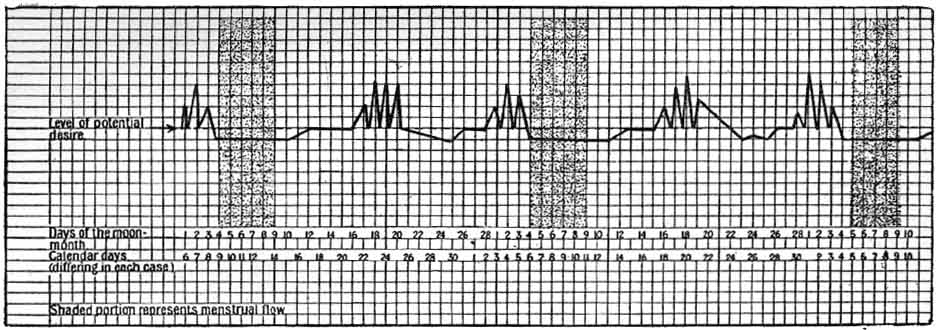 |
Chart 1
[Author's caption] Curve showing
the Periodicity
of Recurrence of natural desire
in healthy women. Various
causes make
slight irregularities in the
position, size and duration of the
"wave-crests," but the general
rhythmic sequence is apparent.
[Read a discussion of this chart
on the second
and third
pages.]
[Chart 2 shows a low, irregular
curve, demonstrating that fatigue
and overwork can disrupt the cycle
of a woman's desire.]
[Note that the peaks
occur about the
time of ovulation and right before the
period, a pattern that I
believe is accepted today.
For producing children it's
valuable that a woman's desire
coincides with ovulation. I
believe that a woman's pheromones
and
vaginal odor also change at this
time, as do other things, such as
viscosity of the cervical mucus
plug, making it easier for sperm
to reach the interior of the
uterus. The opening of the cervix,
which allows sperm to enter the
uterus, also widens.]
|
NEXT
Second, third page, Dr.
Grace Feder Thompson's letter
appealing for patients, Nellie Bly, Lydia Pinkham,
Radcliffe
College, of Harvard
University, has probably the largest
collection of material
about the Pinkham enterprise, the
records of the Lydia E. Pinkham
Medicine Company.
Part of the donation of
SarahAnne Hazelwood to this
museum, much of it patent medicine
and old medical equipment, was a
very interesting biography and
study of Mrs. Pinkham's business,
Female
Complaints: Lydia Pinkham and
the Business of Women's Medicine,
by Sarah Stage.
See two letters to MUM about the
ingredients
of her Compound, and one
about the lyrics of an English pop
song,
Lily the Pink, about her.
Other amazing
women: Nelli Bly, Dr.
Marie Stopes,
Dr. Grace Feder Thompson
See also the patent medicine
Cardui,
Dr. Grace Feder Thompson's
letter
appealing for patients, Dr. Pierce's
medicines, and Orange
Blossom medicine.
©
2000 Harry Finley. It is illegal
to reproduce or distribute work
on this Web site in any manner
or medium without written
permission of the author. Please
report suspected violations to hfinley@mum.org
|
|