And
read comments from people who have
used a cup.
Do cups
cause endometriosis? Not enough evidence,
says the FDA.


|

Introduction to a History of the Menstrual Cup
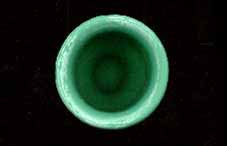
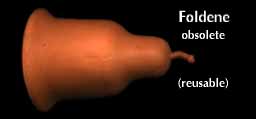
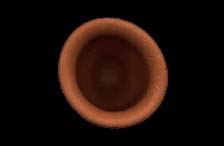
(PICTURES of cups
at the bottom of this page)
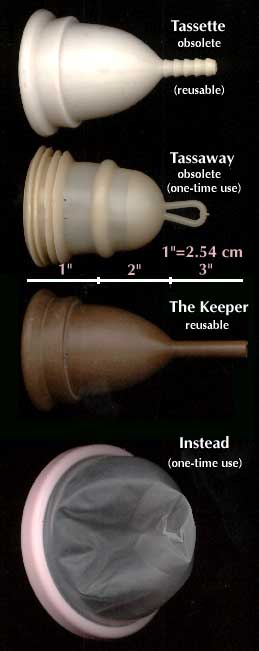
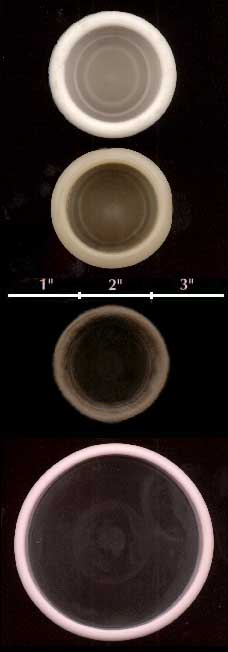
The commercial menstrual cup
(photos below),
a device inserted into the vagina
to collect, but not absorb,
menstrual blood, has been around
at least since the 1930s,
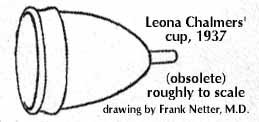
when the American Leona W.
Chalmers patented it (see
part 1
of the history of the menstrual
cup); an earlier
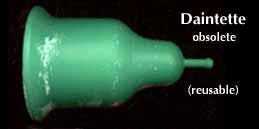
patent also exists for
the Daintette
cup - its history is less clear.
(Read more about
the history of
the menstrual cup - First cup?
Tassette,
Tassaway,
The Keeper,
Daintette,
Foldene,
Gynaeseal)
Women
didn't buy many of the Chalmers
cups when the company sold the
hard rubber cup right before
World War ll, and it failed.
It wasn't until 1959 that
Tassette, Inc., began marketing a
softer version, in collaboration
with Leona Chalmers. It also
failed, in the early 1960s.
Women today can buy the reusable
The
Keeper, sold since the late
1980s; the one-time use Softcup (Web
site, which was once
Instead's, which Ultrafem started
selling in the fall of 1996 in the
western part of the U.S.A.; it's a
long story); the British Mooncup (Web
site); the Canadian DivaCup,
made of silicone (Web
site); and the Finnish
Lunette cup (Web site no longer
working); and more.
(PICTURES
of cups at the bottom of this
page)
MUM board member Dr. Philip
M. Tierno, Jr., director
of clinical microbiology and
immunology at the New York
University Medical Center,
kindly donated both the uncommon
Tassette and Tassaway cups
(below) to this museum. Robert
Oreck, president of the company
that made the Tassette cup, gave
the cup to Tierno, who then gave
it to MUM. Dr. Tierno is world
renowned for his research into
the safety of menstrual hygiene
products. Harry Finley, director
of MUM, took the photos of the
cups, which are in the museum
collection.
|
|
|
|
|
|
|
|
|
Harry Finley, director of
MUM, took the photos of the
cups, which are in the museum
collection.
|
|
|
© 1997-2013 Harry Finley. It is
illegal to reproduce or distribute
any of the work on this Web site
in any manner or medium without
written permission of the author.
Please report suspected violations
to hfinley@mum.org
|
|