Leona
Chalmer's 1937
book with a
drawing of a cup.
And
read comments from people who have
used a cup.
Do cups
cause endometriosis? Not enough evidence,
says the FDA.


|

A History of the
Menstrual Cup
Leona Chalmers possibly produces the first
commercial
menstrual cup, around 1937
Ad at bottom of page
  |
Illustrations
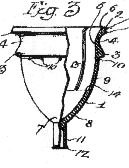
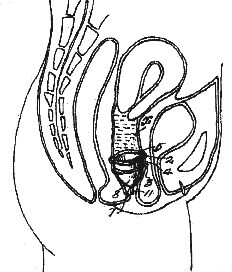
from the Chalmers patent.
|
Two important innovations in
menstrual hygiene occurred in the
1930s: the commercial
tampon and the menstrual cup
(although a strange
predecessor was patented in
1867, as were others later, not
only in the U.S.A.). But because
of certain characteristics of
these devices, neither threatened
the reign of the sanitary napkin,
essentially meaning Kotex. This
remains true (although Kotex is no
longer the top-selling pad).
The drawing of the cup from
Leona Chalmers's patent (U.S.
patent 2,089,113) (far left) shows
that it is very similar to the
Tassette, Tassaway and The Keeper
cups produced later (see photos).
Chalmers suggested in the patent
that it be made of vulcanized
rubber. (She discusses its use and
shows a drawing in her book
from 1937.)
According to Robert Oreck, the
founder and president of Tassette,
Inc., a later company started in
the late 1950s, this first cup
started production just as World
War ll began, and stalled because
of the shortage of rubber. Women
did not like the cup because it
was hard, too heavy and, I
suspect, simply because they did
not want to put things into their
vaginas with their fingers. The
Tampax tampon, first sold in 1936,
met similar resistance from the
public and also from doctors, who
had some medical objections.
This raises the issue of femininity.
Advertisers for menstrual hygiene
products use the word to mean
daintiness and delicacy and
avoidance of unseemly words,
actions and things, including
those related to sex and the
body's secretions. Ladylike and
modest might mean the same thing.
Especially American women wanted,
and many still want, to avoid the
reality of menstruation, with its
messiness, unpredictability and
its undertones of the unclean,
sex, and sexual avoidance. Most
women must overcome many barriers,
some very practical, before they
will put their fingers into their
vaginas.
The drawing at top right, also
from this patent, shows where the
cup sits, low
in the vagina, just where the
three successor cups sat (which
includes The Keeper). The most
recently developed cup, Instead,
rests high
in the vagina, near the cervix,
which
I think even more affronts the
feeling of femininity, and also
of cleanliness, still held by
many women. But Instead is not
aiming for a large market.
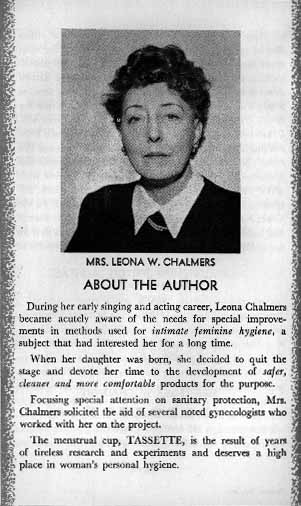
Mrs.
Chalmers, who continued to sell
the cup after the war, wrote the
undated booklet below (here we
see the cover and an interior
page; I made the pages different
sizes to save a bit of bytes)
sometime between the late 1930s
and the middle 1950s, probably
before she joined with Robert
Oreck in 1957 in a second (text
continued under the pictures)
|
|
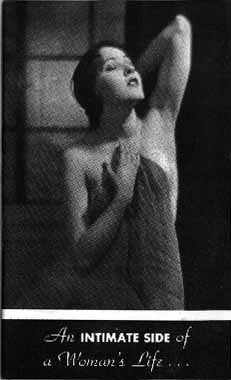
Above:
A booklet
expaining her
invention, the
Tassette menstrual
cup, by Leona
Chalmers (cover
above, reduced,
and an interior
page). Her book
from 1937
has almost the
same title and
does use the same
photo for the dust
jacket. Tambrands
gift,
1997.
|
|
 |
|
Below:
An undated ad from an
unknown magazine, but
before 1963,
which is when ZIP codes
appeared. Tassette is
spelled Tass-ette.
It's possible this
advertises the cup
Chalmers sold in the 1950s
before Robert Oreck
launched his version of
the Tassette based
on Mrs. Chalmers's second
patent. The American
Medical
Association made Tampax
stop putting the AMA
statement you
read below because it
implied endorsement.
Tambrands
gift, 1997.
|
Below:
A note that the company
enclosed with her
booklet, above left.
Date unknown.
How
personal
can a piece of paper
be when reproduced
probably by the
thousands?
Tambrands
gift, 1997.
|

|
 |
|
attempt to
sell the Tassette, this time on
a large scale. The style of the
photographs suggests the 1930s.
It was the
late 1950s before the cup
reappeared (part 2) on a
large scale, and this time Mrs.
Chalmers was working with Robert
Oreck, but
America had hardly changed in
its attitudes towards the cup.
It still has not.
(Most of the information above
about Tassette, Tassaway and
Chalmer's patent came from
Advertising Age, Barron's, Drug
Trade News, Editor and Publisher,
Investment Dealer's Digest from
the 1960s and 1970s; and from a
Stock Prospectus dated 28 August
1961, all gifts of Tambrands,
1998. Mr. Oreck refused my request
for an interview, referring me to
another company official, nurse
Barbara Waldron; I could not find
her but see a picture.)
© 1997-2006 Harry Finley. It is
illegal to reproduce or distribute
any of the work on this Web site
in any manner or medium without
written permission of the author.
Please report suspected violations
to hfinley@mum.org
|
|