Leona
Chalmer's 1937
book with a
drawing of a cup.
And
read comments from people who have
used a cup.
Do cups
cause endometriosis? Not enough evidence,
says the FDA.


|

A History of the
Menstrual Cup (continued)
Robert P. Oreck and
the Second Attempt to Sell The Cup:
Tassette
(see a 1961
prospectus and instructions and
promotional material, 1956(?)-1960s, & historical introduction)
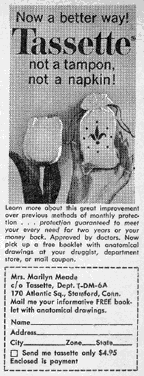 |
(Above) A flower,
the tulip, "euphemizes"
the menstrual object, the
cup. (Ad in Modern
Screen, June
1962)
|
|
Educating the public was the
main task facing Robert P. Oreck,
who bought the rights to a second
Chalmers patent (from 1950) and
started a new company, Tassette,
Inc., in May 1959, to sell the new
Tassette
menstrual cup (bottom of page),
which looked very much like the
Chalmers cup, and would meet
similar objections from the
public.
It was a family affair: his wife
Shirley was vice president for
education, and his brother David
was a director of the company.
Brother Marshall, general manager
of a company which distributed
vacuum cleaners (an eerily similar
enterprise!), was later involved
with the successor to Tassette,
Tassaway. Robert Oreck himself was
the president of Lincoln
Institute, a Spanish language
correspondence school.
Aware of the difficulties Tampax
had had with the medical
community, Oreck mailed discounted
offers of the $4.95 cup (which was
reusable and had a money-back
guarantee) to thousands of
registered nurses, many of whom he
said preferred it to pads and
tampons. And like Tampax, he hired
nurses to give advice to women at
drug and department stores in the
northeastern and east-central part
of the U.S.A., where the campaign
started (and ended) with direct
mailings. (The campaign for the
Instead cup in 1996 started in the
northwestern part of the U.S.A.,
which the Ultrafem company, maker
of Instead, determined had the
greatest percentage of users of
non-applicator tampons, women who
seemed not to object to inserting
their fingers into their vaginas.
Perhaps the fate of Tassette would
have been different if it had
started there.)
By adding an anti-bacterial
treatment to the surface of the
cup he hoped to increase its
acceptance in the medical
community and with the public.
|
The Seamless Rubber Company of
New Haven, Conn., a division of
Rexall, manufactured Tassette.
Oreck placed newspaper ads
through cooperating department
stores and drugstores, although
women's page editors seldom
mentioned Tassette, because of its
function. One ad was headed (hold
your breath), "New - Monthly
Protection as Dainty as a
Dew-Kissed Flower," which
referred to the use of a tulip to
illustrate the cup. (See the
ad above from the magazine Modern Screen,
June 1962. The booklet
it offered was entitled "A Fresh
Point of View." Fresh is a
favorite word with feminine
hygiene advertisers). The
cup was "impossible to illustrate
in consumer advertising for
obvious reasons," he said, and the
choice of a
flower is an interesting, and
probably unconscious, reference
to the word flowers, synonymous
with menstruation for centuries.
But to reach his 'Sixties
audience, he was forced to use a
time-honored "feminine" approach,
avoiding the word menstruation,
showing a flower - how feminine
can you get? - and employing the
name Tassette itself, which sounds
French and cute to Americans.
(According to my dictionary, it
means thigh
armor in French. Tasse
itself means cup. I
think the company was creating a
word meaning little cup,
-ette being a diminutive.) (Continued
below the picture.)
But newspapers wouldn't let him
use the words vagina
and vaginitis,
and an advertising
association protested his
buying a 40'
by 30' billboard space in Times
Square in New York City (above)
showing basically what we see in
the ad above. (Look at what Kotex
did in the 1920s!)
Radio spots were harder to get,
and one began with a woman saying,
"As a doctor, I recommend
Tassette. As a woman, I rave about
it. To me personally, Tassette is
more than monthly protection. It's
a blessing."
Oreck also sold a menstrual pain
reliever called Tachine and a
"menstrual skin preparation,"
which he hoped to market with the
cup.
Tassette never made a profit and
the cup disappeared in 1963. Oreck
said the reasons it failed were
the reluctance of the public to
clean and reuse the cup; and its
reusability of three to five
years, so satisfied customers
would not buy it again soon.
(As a footnote, according to the
U.S. Patent and Trademark Office,
on April 27, 1982 the Plastic
Applications, Inc. Corporation
Florida, 2608 NW 2nd Ave., Boca
Raton, Florida, 33431, registered
the Tassette trademark but
abandoned it June 30, 1983.)
But Tassette, Inc., did not die,
and the Tassaway cup appeared in
1970, which Oreck hoped would
solve Tassette's two basic
problems. See what happened.
(Most of the information above
about Tassette, Tassaway and
Chalmer's patent came from
Advertising Age, Barron's, Drug
Trade News, Editor and Publisher,
Investment Dealer's Digest from
the 1960s and 1970s; and from a
Stock Prospectus dated 28 August
1961. Mr. Oreck refused my request
for an interview, referring me to
another company official; I could
not find her.)
© 1997-2006 Harry Finley. It is
illegal to reproduce or distribute
any of the work on this Web site
in any manner or medium without
written permission of the author.
Please report suspected violations
to hfinley@mum.org
|
|