

|

THE MUSEUM OF MENSTRUATION
AND WOMEN'S HEALTH
Former museum–Future–Comic
strip about a visit to the museum
Sponges for contraception - birth
control - and absorbing menstrual flow
Women have probably used sponges
to absorb menstrual discharge for thousands of
years, but they have also used them as
contraceptives and for putting medication into
the vagina (as with tampons; see hieroglyphics
from about 1550 BCE). Sometimes it's hard to say
which sponge was used for what - but maybe women
sometimes used them for all three purposes.
During the era of the Comstock
Act in the U.S.A., 1873 to well into the 20th
century, when contraception was illegal,
American women used sponges to hold liquids that
killed sperm as well as to absorb menstrual
blood, but ads could not say this. Thus the
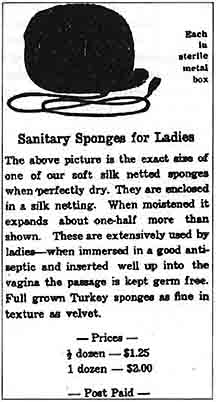
assertion in the ad, below, that the sponge
could keep the vagina "germ free," similar to
the wording of douche ads (see a Lysol ad, among others,
for this dual purpose).
|
|
The ad is from the American Medical
Association Archives, Chicago, and reproduced
in Devices &
Desires: A History of Contraceptives in
America, by Andrea Tone (Hill and
Wang, 2001 - buy
it). Undated, it looks to me as if it's
from the early 20th or late 19th century.
Professor Tone notes that the word "germ"
really means "sperm."
See examples of this
box and sponge, below.
But first . . .
|
|
Cleaning sponges
Dr. Philip Tierno, Jr., a MUM board member and
expert on the safety of menstrual products,
writes (October 1999), in part,
The odor emanating from the used and washed
sponges represent the action of surviving
vaginal bacteria and their degradation of
menstrual debris that survives the wash. The
only effective way to sanitize those sponges
is by boiling for about
5 to 10 minutes. This will kill ALL
bacteria there.
Interestingly, looking back in history,
women used to boil their menstrual "rags" to get
them clean. This is an analogous circumstance.
John Fleer, who lives in Michigan (U.S.A.),
searched for patent medicine bottles in old
drugstores in the central part of the U.S.A. for
many years, and came upon this
menstrual sponge (the orange can, below)
about 1966 in an area of Kansas located next to
an Army training area during World War II. The
drugstore was deserted, although bookies had
used it recently for their illegal operations!
He kindly donated it to MUM after reading an
article about this museum in the Chicago
Tribune.
Both the red cross and the word "health" make
the medical connection to menstruation, a
hangover from the medicalization of menstruation
in the last century, which apparently occurred
because of the feeling of shame Victorianism
caused women to feel about their bodies. Mothers
then abandoned teaching their daughters about
their periods; doctors - males - took over by
default, and the rest is history.
But the word may also refer to its possible
use as a birth-control device.
Dr. Barbara Czerwinski, of the University of
Texas, a MUM board
member, who has completed a study for the
U.S. Department of Defense of the hygienic
requirements of female members of the Armed
Forces, believes the U.S. Army may have issued
this sponge to female troops (WAC) destined for
the South Pacific.
The National Museum of American History of the
Smithsonian Institution has three similar
examples of sponges (at least it did in 1995).
|
|
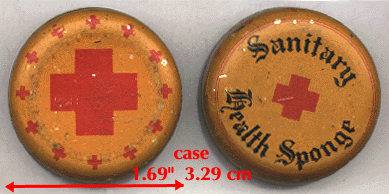
This is the sponge (below) and
case (bottom part at left) John Fleer sent to
MUM, which was perhaps available during World
War II.
|
|
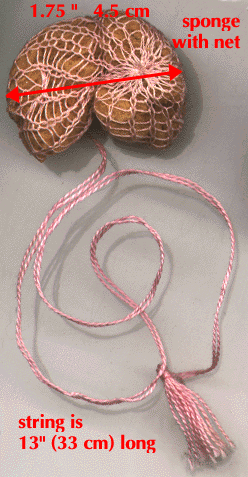
The contents of the above
can.
|
|
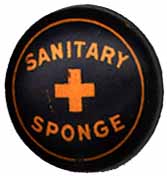
You are looking at another case,
date unknown, from an angle. It is virtually the
same size and shape as the first sponge can,
although the top is
slightly domed. The can is empty.
See a similar but
not identical can with sponge.
|
Below:
Again, another sponge and case are virtually
identical to the Fleer sponge, above.
A woman in an American Pacific
coast state found two of these in the effects
of a deceased aunt and generously sent one to
the museum in July 2001. Figuring
backwards from her age, her aunt probably
bought it between 1920 and 1930 - unless SHE
inherited it! The typography reminds me of the
1930s - 1940s.
|
The case matches the Fleer sponge in size.
|
|
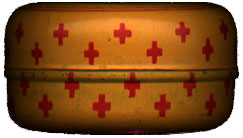
Side view
|
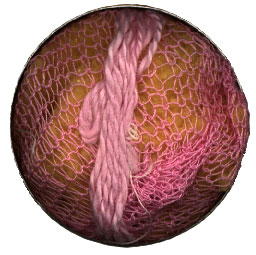
The sponge nestled in its case.
|
© 2001 Harry Finley. It is illegal to reproduce or
distribute any of the work on
this Web site in any manner or medium without written
permission of the
author. Please report suspected violations to hfinley@mum.org
|