See the fax tampon and the almost
identical tampon Nunap sold probably about the
same time, both probably made of Cellucotton,
the component of Kotex.
See other marketing
devices: Ad-design contest for menstrual
products in the United Kingdom; B-ettes tampon
counter-display box and proposal to dealers,
with contract; (U.S.A., donated by Procter &
Gamble, 2001); "Your Image
is Your Fortune!," Modess sales-hints
booklet for stores, 1967 (U.S.A., donated by
Tambrands, 1997)
See a Modess True or
False? ad in The American Girl magazine,
January 1947, and actress Carol
Lynley in "How Shall I Tell My Daughter"
booklet ad (1955) - Modess
. . . . because ads (many dates).


|
THE MUSEUM OF MENSTRUATION AND WOMEN'S HEALTH
Cutting
to the chase: Another reason I started
the museum
Photos at the
bottom of the page
The museum homepage
On March
23 and 1 April, 2007, a neighbor
killed two cats and threw them into my
(MUM founder Harry Finley's) yard. He
injected poison into one, my cat Wix, and cut the
throat and opened the stomach of the
other, Wix's shy, stray friend. I
cried and cried and wore dark glasses
in public for weeks. The police and
city council and mayor knew this and
more, and didn't do anything, and I
didn't feel safe. So I've decided to
tell you a story from my teenage years
in case I don't have the opportunity
again. The story sheds light on why I
started this museum.
When I was 15 I cut my arms and
torso over a hundred times with a
razor blade and piece of broken
glass (photo at the bottom of
this page). In the several
months before this I had poured acid
down my back and onto my hand - I
still have faint scars, decades
later - as well as swallowed dozens
of aspirins and overdosed on
barbiturates more than once.
Ashamed, I said strangers cut me.
I was desperately trying to escape a
family where I felt trapped by a
brother dying from muscular dystrophy,
and by his beleaguered caretakers, our
parents (photos below). An ironically
titled book brilliantly describes this
situation: Dr. Jeanne Safer's The
Normal One: Life with a Difficult or
Damaged Sibling. The Normal One
was not-so-normal me. As she writes,
Dr. Safer was also - is? - not so
normal.
Cutting myself (which required 31
stitches) propelled me out of the
family and sophomore year in high
school and into the Army's psychiatric
ward on Okinawa, the occupied Japanese
island where my father was in charge
of construction for the U.S. military.
After a couple weeks in a locked ward
I spent a few more in the Army's
locked psychiatric ward in Tokyo (at
right). From there I was flown
to Hawaii (for only three days,
unfortunately) and finished my locked
ward career with two months in San
Francisco, in the now closed Letterman
Army Hospital. After a month I
graduated from its locked to, yes, an
unlocked ward from which I could visit
my mother and little brother, who had
moved to San Francisco to be near me.
For the first time in my life I
felt free. But it took me decades to
somewhat
overcome my shyness, the desire to
be always agreeable, and my
goody-goody-ness, which Safer lists
as characteristics of the Normal
One: Children don't want to give
suffering parents and the sick child
even more trouble. Ironically,
cutting myself and spending time in
a mental institution did just that.
Until I opened this museum in my
house in 1994 (here)
I had never rebelled, a word a
museum visitor used but had never
occurred to me. She was right. And I
still would not have done it had my
parents been alive. They would have
been horrified. It was not so
rebellious an act as it might seem.
In 2011 the New York Times ran an
article about borderline
personality disorder and a
woman, Dr. Marsha Linehan, who has
created a new treatment for it - she
had the illness herself. It
described symptoms that matched
mine. I never knew what my diagnosis
was but I suspect this was it. I
also had and have untreated ADHD,
not being able to tolerate the
medication.
What was it like in the psychiatric
wards? I was always the youngest,
surrounded by sick soldiers and their
sick spouses. I never felt mistreated.
I drew a pencil portrait of a
bent-over soldier who had shot himself
in the stomach with his rifle (he
pulled the trigger with his toe); he
drew one of me that turned out to be
Mickey Mouse. An old sergeant had
delirium tremens. At night I sometimes
heard screams from the padded cell of
a usually friendly and funny fellow
who cycled into and out of sanity. And
once at breakfast I remember a woman
sitting stiffly, staring straight
ahead, with an ear-to-ear scar across
her throat. A gay soldier
unsuccessfully tried to convince my
mother to let me visit him after he
was released - he told me (but not my
mother!) he had a bed that sloped
toward the center. Only later did I
realize what that meant; I was naive
and anyway not of that persuasion -
er, genetic disposition. Looking
through that ward's windows I drew
scenes of Tokyo and still lifes in the
ward in San Francisco, prefiguring my
life as an artist. Life wasn't
bad.
In the San Francisco hospital I
tried to catch up with school by
getting geometry and English books out
of the hospital's library. I asked my
psychiatrist for help with geometry
problems. He would stare at the page,
puff on his pipe and ask the
psychiatric social worker. Both looked
baffled by theorems and triangles.
The social worker, an Army
lieutenant colonel, once called me
into his office and asked, "Do you
masturbate?" "No," I said, even though
I wasn't sure what that meant. He
said, "Ninety-nine out of a hundred
boys say they masturbate and the other
one's a liar!" He later
asked the same question and got mad
when I gave him the same answer.
After I got out - the doctors
advised against it but I was desperate
to be "normal" and not fall back a
grade in high school - I returned to
school, having missed the first half
of my sophomore year but somehow was
never required to make it up. The next
year I had the highest grades of the
junior class - and I had the highest
grade in geometry class in the second
half of my sophomore year. A couple of
years later I was in college. I was on
a decades-long difficult trek to
recovery.
|

Above: I drew the view
from my bed in Tokyo Army Hospital, in
a locked psychiatric ward, ward
21. I was 15.
|
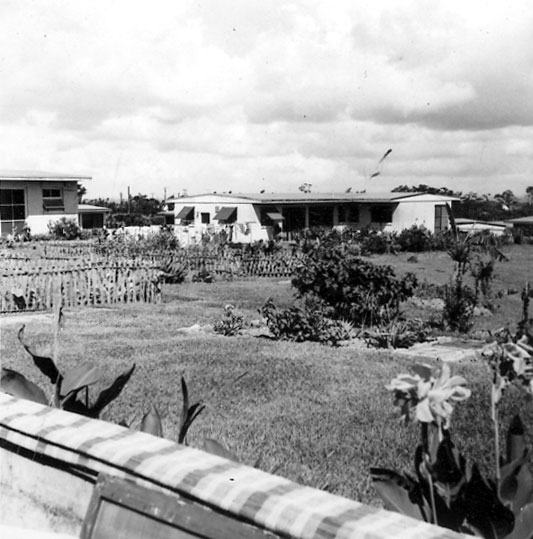 |
Above:
In Okinawa's Sukiran Army
housing area, Colonel
Joyce and his family, one
of my father's employees,
lived in the house at top
center. It was identical
to ours; you see our patio
wall in the foreground.
Houses had to be flat to
endure the several
typhoons - hurricanes -
that thumped the island
every year. Okinawa has
more people one hundred
years old and older per
capita than any other
"country" in spite of the
wind and heat and
humidity. (Photo: Harry
Finley with a Ricohflex
camera my parents gave me
for Christmas.)
|
|
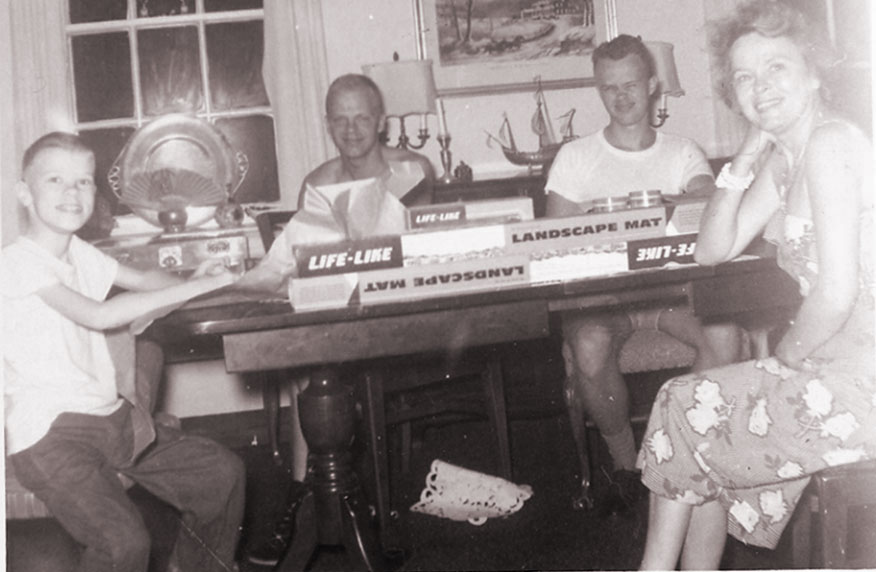 |
Above:
Eight months after I got out of the
hospital and back into school
someone, maybe my father, took this
picture in our house at Ft. Belvoir,
Virginia. Jim, my brother with
muscular dystrophy, sits at left. He
had trouble walking because of the
disease. Then you see my older
brother, George, Jr.; me; and our
mother. My father had a weakness for
Currier & Ives prints, on the
wall. I have no idea what the
Life-Like Landscape Mat was, or why
I was squinting (maybe I was
anticipating the camera flash).
Mom's head was not really that big;
she was just 4'11" tall. And the
photographer - Pop? - might have had
one too many, listing to one side.
|
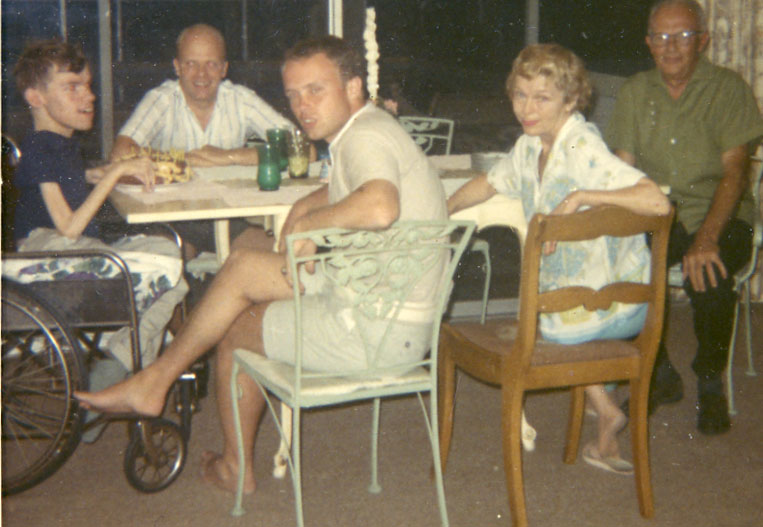 |
Above:
Eight years later Jim was
much worse and in a
wheelchair. Look at his
arms. He couldn't
straighten his
extremities. He would die
three years later of a
heart attack while my
father was giving him a
bath, at 21, an age at
death typical for Duchenne
muscular dystrophy
sufferers. My mother,
second from right,
followed him five years
later, from grief. A
doctor told her she had
passed the faulty muscular
dystrophy gene to her son,
as in "It's your fault."
That's my brother George,
Jr., second from left (he
had the ability to rotate
his pupils to face his
brain but stopped doing it
when they got stuck more
than once; I'm just
kidding); me; and my
father - Pop - at far
right. The picture shows a
room in our house in
Satellite Beach, Florida,
when Pop was in charge of
construction at the Cape
Canaveral launch site
for NASA. Jim was
intelligent, funny, and
seemed cheerful to the
end. I never talked about
his illness with him -
isn't that incredible? -
and I doubt that my
brother had. (Photographer
was probably a high school
student we hired a few
hours each week to keep
Jim company.)
|
|
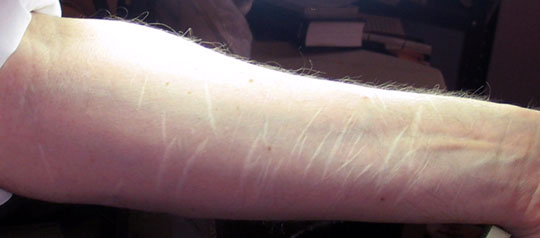 |
Above:
These cuts and others - my
other arm looks like this
as well as my sides
- landed me a three
months' stay in four
hospitals and ruined Pop's
Army career. He had to
give up his best job to
accompany his family back
to the States. This is how
my left arm looked in
2007. I was so ashamed of
having cut myself that I
told the doctors and my
family that some unknown
person had done it. But
the direction of the cuts
told them it was me. After
I left the hospital my
family and I almost never
discussed the incident or
its cause. It was a hard
subject to bring up.
(Photo: Harry Finley)
Go to a short bio
or see some of my art
(and my art
site) and the former
museum
in my house. Cats
of this museum and feline
felicities.
|
|
© 2015 Harry Finley. It is illegal to
reproduce or distribute
work on this Web site in any manner or medium
without
written permission of the author. Please report
suspected
violations to hfinley@mum.org
|