See the fax
tampon and the almost identical tampon Nunap
sold probably about the same time, both
probably made of Cellucotton, the component
of Kotex.
See other marketing devices: Ad-design contest for
menstrual products in the United Kingdom; "Your Image is Your
Fortune!," Modess sales-hints booklet
for stores, 1967 (U.S.A., donated by
Tambrands, 1997)
See early tampoms Wix
and Dale and a bunch of other
earlier ones.
See some Kotex items: First ad
(1921) - ad 1928 (Sears
and Roebuck catalog) - Lee Miller ads
(first real person in amenstrual hygiene ad,
1928) - Marjorie
May's Twelfth Birthday (booklet for
girls, 1928, Australian edition; there are
many links here to Kotex items) - Preparing for
Womanhood (1920s, booklet for girls;
Australian edition) - 1920s booklet in
Spanish showing disposal
method - box
from about 1969 - "Are
you in the know?" ads (Kotex) (1949)(1953)(1964)(booklet, 1956) -
See more ads on the Ads
for Teenagers main page


|

B-ettes menstrual tampon
(U.S.A., 1935?)
Box and
newspaper ad (1935, at bottom of
page)
B-ettes joined the flock of
American 1930s tampons without
insertion devices; the museum has
only two applicator tampons from
the first decade of commercial
menstrual tampons, Tampax
(1936) and LOX
(1940?), the applicator, I think,
helping women accept the idea of
tampons.
You won't find the the word
"tampon" on the box or in the
instructions, maybe because many
women still weren't familiar with
the word, or because the company
wanted to substitute its name for
the wad of cotton that would
become so important in many
women's lives.
So how do you pronounce
"B-ettes"? "Bee-ets"? "Bets"?
"Betties"? Dr. Lillian Gilbreth
would have laughed at this
ambiguity and predicted the
brand's early death (in her 1927 report
to Johnson & Johnson). The
company spent much money on
advertising in 1938-39, as pitched
in its proposal to dealers (here),
but I suspect Dr. Gilbreth was
right.
Procter & Gamble kindly
donated the box and contents as
part of a gift of scores of
menstrual products.
|
|
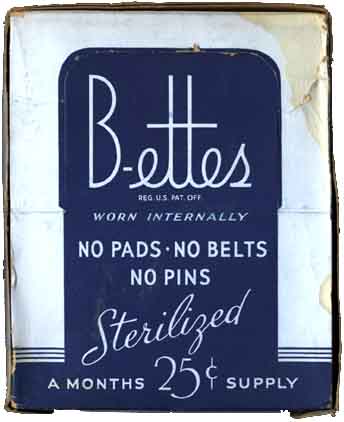
As with some other
tampons of the time, nothing on
the box tells a women how many
tampons are inside (12), just "A
month's supply" on this display
case (see it open) -
nothing at all on the individual
boxes.
The price comes out to be a tad
over 2¢ apiece, about what
other contemporary tampons cost
(LOX, with an applicator, cost
more than twice as much).
"No pads, no belts, no pins"
mimics what the text on many other
contemporary tampon boxes shouted,
and justifiably. Tampons
encouraged women to get out into
the world and on an almost equal
footing with men.
This display box
measures 5.375" x 3.375" x 1.75"
(13.3 x 11 x 4.4 cm).
|
|
|
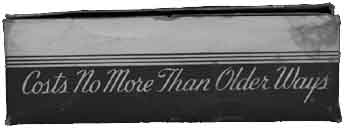
"The
older ways" meant mainly
pads and belts, although cups and
sponges existed at this time, but
I suspect women hardly used
them.
|
|
|
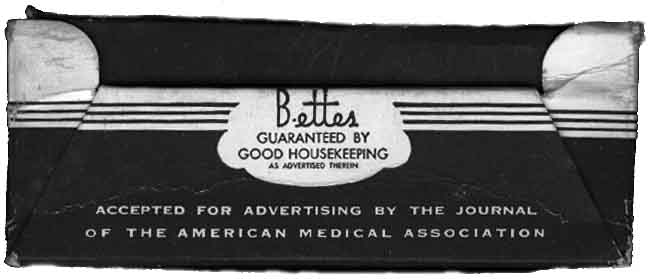
The American Medical
Association chided
Tampax for using this
implied endorsement on
its packaging (Tampax
took the statement off),
but this usage seems to
have been common. Good
Housekeeping, of course,
was an American magazine
that lent its guarantee
to certain products.
|
|
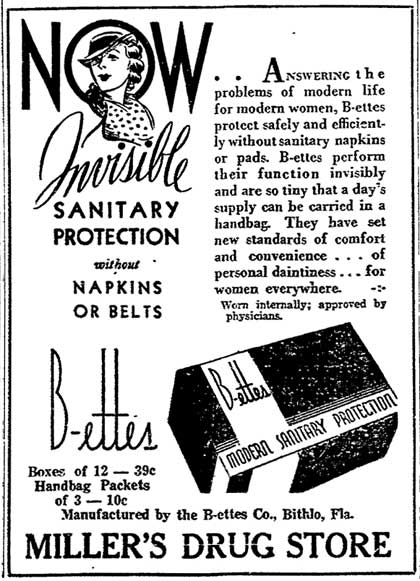 |
The ad appeared in the
Indiana Evening Gazette,
Indiana, Pennsylvania,
on Friday, December 6,
1935, at the bottom of
page 13 between ads for
groceries. The instructions
and proposal
to
dealers show
addresses in
Pennsylvania and New
York, not Florida. I
hope they weren't one
step ahead of the law! I very
much thank a genealogy
researcher for sending
this scan and several
other others of
tampons and other
information from
mid-twentieth century
newspapers!
|
|
© 2001 Harry Finley. It is illegal to
reproduce or
distribute any of the work on this Web site
in any
manner or medium without written
permission of the author. Please report
suspected violations to hfinley@mum.org
|