See the roughly contemporary Cashay and Dale tampons, and
very early Tampax
and fax.
See a shorter
version of the report published in
Consumer Reports, in the September 1945
issue. It is less technical than the JAMA
original, although approved by Dickinson.


|
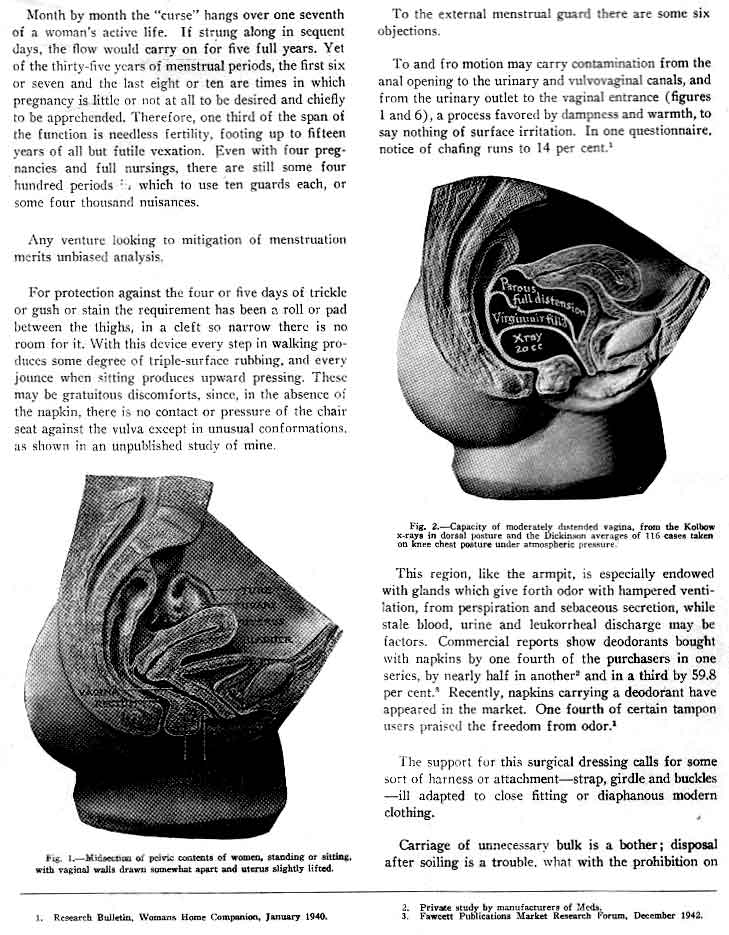
"Tampons as menstrual guards"
("The Dickinson Report," 1945)
This 1945 reprint, with minor
additions, of the report of Dr.
Robert L. Dickinson, entitled
"Tampons as menstrual guards," in
the 16 June 1945
issue (Vol. 128, pp. 490-494) of
the Journal of the American
Medical Association was important
for its promotion
of tampon use and the tampon
industry, and the discouragement
of the use of pads by women.
Using tampons meant inserting
something into the vagina,
territory mothers told their
daughters to stay away from.
(Interestingly, one reason
Dickinson gives for avoiding pads
is the sexual stimulation of the
woman by the friction of the pad
against the vulva.) Many women,
even today, believed that tampons
could block
the menstrual flow rather
than absorb it (a doctor recommended
them for this very reason).
And there are other reasons
discussed by the doctor.
Dr. Dickinson made training
material for Tampax tampons (see some
here), which clouds his
impartiality (in my view). I don't
know if he worked for other tampon
companies, which multiplied during
the 1930s (see some here).
Compare some of the advantages
and disadvantages of pads with the
ones that Dr. Lillian Gilbreth
discussed in her lively 1927
report to the Johnson &
Johnson Company, which appeared
before women could buy commercial
tampons in the early 1930s.
The two
blistering opening paragraphs
speak for many women today. I
wonder what Dr. Dickinson would
say about menstrual-suppression
pills like Seasonale.
Read a
long excerpt from Dr.
Dickinson's book Control of
Conception (1931/32).
See a shorter
version of the report
published in Consumer Reports,
in the September 1945 issue. It
is less technical than the JAMA
original, although approved by
Dickinson.
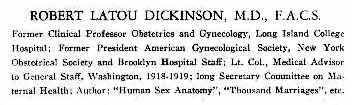
A Dutchman kindly donated
scans of this report to MUM,
which bears the following
biographical information on its
first page before proceeding to
the text, below, on page 2:
|
|