See more Kotex items: Other
first-campaign ads: May
1921 - July
1921 - November
1921. Ad 1928 (Sears
and Roebuck catalog) - Marjorie May's Twelfth
Birthday (booklet for girls, 1928,
Australian edition; there are many links
here to Kotex items) - 1920s booklet in
Spanish showing disposal
method - box
from about 1969 - Preparing
for Womanhood (1920s, booklet for
girls) - "Are you in the
know?" ads (Kotex) (1949)(1953)(1964)(booklet, 1956) -
See more ads on the Ads
for Teenagers main page
And read Lynn Peril's series about
these and similar booklets!
Even more Kotex items: First ad
(1921) - ad 1928 (Sears
and Roebuck catalog) - Lee Miller ads
(first real person in amenstrual hygiene ad,
1928) - Marjorie
May's Twelfth Birthday (booklet for
girls, 1928, Australian edition; there are
many links here to Kotex items) - Preparing for
Womanhood (1920s, booklet for girls;
Australian edition) - 1920s booklet in
Spanish showing disposal
method - box
from about 1969 - "Are
you in the know?" ads (Kotex) (1949)(1953)(1964)(booklet, 1956) -
See more ads on the Ads
for Teenagers main page


|

The first Kotex sanitary napkin
ad campaign, 1921, and
almost-the-first Kotex ad
(prototype, about 1920)
The First World War changed our
notion of war, paved the way for
Hitler and Stalin, reduced the
power of the European aristocracy
- and gave birth to the first
widely successful disposable
menstrual pad, Kotex. There had
been others, both in Europe and
the United States, but I suspect
women in the English-speaking
world and in Europe, ready to
enjoy increased opportunities, saw
a way to freedom from storing and
washing the often cotton pads.
The Kimberly-Clark Corporation
made bandages for American troops
in Europe and had many left over
after the war. Apparently American
nurses in France found that the
cellulose (which comes from trees,
not cotton plants) wrappings made
very absorbent menstrual pads, and
were fairly cheap, so they could
throw them away. K-C saw an
opportunity, and created the
Cellucotton Products Company to
sell them. The word Kotex retains
its cotton past: it means
[K]Otton-like TEXture, a ruse that
was supposed to make it easy to
buy menstrual pads because clerks
supposedly would not snicker at
the word Kotex; but of course they
did after a while. (Read a report
about problems women had buying
Kotex and other brands and see a way
Kotex tried to get around this.)
The first magazine ad series for
Kotex appeared in 1921 (see ads
for January,
May, July, and
November).
Kotex invested more advertising
dollars in The Ladies' Home
Journal than any other magazine in
Kotex's first 20 years, starting
in January. Wallace Meyer (honored
at this museum), who led the
campaign and wrote the copy for at
least the first ad, had to assure
the publications printing the ads
that the ads would be dignified,
which they were, as you see.
By the way, here are excerpts
from a long letter to the 28
February 1949 Advertising Age
that discussed the "feminine
angle" in ad writing, an
alleged woman writer for the early
Kotex ads, and women in
advertising in general. The
male writer, advertising manager
for the Tupper Corporation, in
Farnumsville, Mass., described
himself as a "scarred, gray and
grim veteran of this profession."
(I left his writing style alone.
The word "copy" means the writing
you read in an ad - the text.):
[A man who supports women in
advertising has] a
lean-on-mother inhibition
[which] assures the gals that
they and only they can
contribute that "feminine touch"
to copy that will make other
women buy. And they believe it.
. . .
There is a well
substantiated piece of
advertising history with which
you may or may not be
familiar. When Kotex was
launched, it was considered
necessary that a very delicate
approach be made; indeed it
was wondered whether ethical
publications would even accept
the copy. [Read the case of
the first real person
in a menstrual ad, Lee
Miller.] So, a woman was
employed to write the copy -
an ex-registered nurse.
Perhaps she had no flair for
writing. In any event the
advertising and merchandising
and sales flopped until a man
was put on the account; I do
not recall who he was, but
Kotex went over. [As I
understand it, Kotex succeeded
when the company told
merchants to display it
on the counter, with a
coin box nearby, allowing
women to buy it without
talking to a clerk.]
I am of the opinion, and
conviction, that the success of
the average gal in business and
particularly in our profession
is gauged by this: If a woman
manages to do a half way
intelligent job she is hailed as
a wonder. Put a man in that same
job and his performance if only
comparable to hers would result
in his getting the well known
gate or being barely tolerated
at the most.
In my book there is a
biological and mental difference
between the sexes and that is
like Kipling's East and West.
For which I am grateful. You see
I am twice married. I played out
the first string until death did
us part . . . .
But please, Lord, deliver us
from career gals and and other
women in business who cannot
resist throwing their sex around
to accomplish ends and
objectives which damn fool
so-called males fall for. To
paraphrase Puck, "What fools we
men be."
And now I am reminded of the
teen-ager, Mary-Lou, on the
Ozzie and Harriet program. Her
gushings and extravagances are
only slightly modified in the
feminine copywriter once she
takes a pencil in hand or begins
to beat the typewriter. That's
just the feminine angle. . . .
John Craig Heady
Paramedics have told me that
menstrual pads - "Kotex" - make
good bandages; they wouldn't be
amazed at their origin. I wonder
if Ernest Hemingway,
an ambulance driver in the First
World War and seriously wounded,
knew that perhaps his bandages had
an unusual future.
(Not to get away from the
subject, but I've learned that Hemingway
loved cats
and had a herd of them on Key
West. You cannot have enough cats.
)
(After a car ran over the hind
legs of his oldest cat in Cuba,
the heartbroken writer shot the
cat in the head to end its
suffering. Witnesses said Hemingway
cried inconsolably, not our
image of him.)
|
|
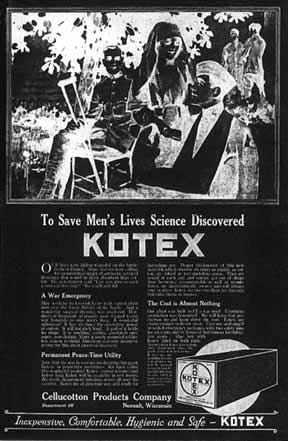
Above and right:
Prototype for the first Kotex ad
(about 1920). This example in
negative form, maybe the only
form, from the State
Historical Society of
Wisconsin, might
be unique. I created the positive
image at right using Photoshop.
The irony about saving men's lives
is huge. But true. Read the
words.
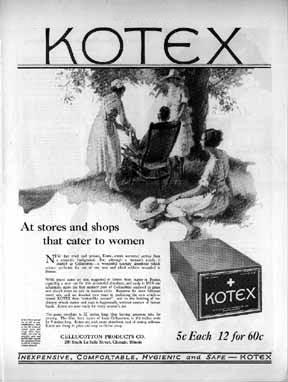
Below:
Below is the full-page ad from one
of the many American magazines
carrying the first series of Kotex
ads in 1921. See it
enlarged and read the
words.
Meyer said in a
paper deposited in his archive at
the State Historical Society of
Wisconsin (where the prototype ad
is found) that the admen rejected
the prototype shown above and at
right because there were too many men
for a product designed for women.
The group effectively reversed the
proportion of men to women in the
actual first ad, below, and
greatly altered the ad words.
|

|
|
|
|
Other first-campaign ads: May 1921 - July 1921 - November 1921
© 1999 Harry Finley. It is illegal to
reproduce or distribute any of the
work on this Web site in any manner or
medium
without written permission of the author.
Please report suspected
violations to hfinley@mum.org
|