o.b. ads
German (early 1950s) - German (1970s) - German nude (1970s) - French (1989)
Australian douche ad (ca. 1900) - Fresca douche (date ?) - Kotique douche 1974 ad - Liasan (1) ad - Liasan (2) ad - Lysol 1928 ad - Lysol 1948 ad - Marvel 1926 ad - Midol 1938 ad - Midol 1959 booklet - o.b. German (papyrus tampons) - Pristeen 1969 ad - o.b. German (nude) - Sterizol 1926 ad - Vionell spray 1970 ad (Germany) - the odor page
A British Tampax ad using nudity (1992) - And see other ads directed at teenagers.
See a Modess True or False? ad in The American Girl magazine, January 1947, and actress Carol Lynley in "How Shall I Tell My Daughter" booklet ad (1955) - Modess . . . . because ads (many dates).
CONTRIBUTE to Humor,
Words and expressions about
menstruation and Would
you stop menstruating if you could?
Some MUM site links: homepage
| MUM address & What does
MUM
mean? | e-mail
the museum | privacy on
this site | who runs this
museum?? |
Amazing women! | the art of menstruation | artists (non-menstrual) | asbestos | belts | bidets
| founder bio | Bly, Nellie | MUM board | books:
menstruation and menopause (and reviews) | cats
| company booklets for girls
(mostly) directory | contraception
and religion | costumes |
menstrual cups | cup usage | dispensers | douches, pain, sprays | essay directory | extraction | facts-of-life booklets for
girls | famous women in
menstrual hygiene ads | FAQ
| founder/director biography | gynecological topics by Dr.
Soucasaux | humor | huts | links
| masturbation | media coverage of MUM | menarche booklets for girls
and parents | miscellaneous
| museum future | Norwegian menstruation exhibit |
odor | olor
| pad directory | patent medicine | poetry directory | products, current | puberty booklets for girls and
parents | religion | Religión y menstruación | your
remedies for menstrual
discomfort | menstrual products safety
| science | Seguridad de productos para la
menstruación | shame | slapping, menstrual | sponges | synchrony | tampon directory | early tampons | teen ads directory | tour of the former museum (video) | underpants & panties directory
| videos, films directory |
Words and expressions about menstruation | Would you stop menstruating if you could? | What did women
do about menstruation in the
past? | washable pads
Leer la versión en español de los siguientes temas: Anticoncepción y religión, Breve reseña - Olor - Religión y menstruación - Seguridad de productos para la menstruación.



THE MUSEUM OF MENSTRUATION AND WOMEN'S HEALTH -
1996
Next earlier news - Next later news
The Most Flattering of All Diseases
This is not menstruation (for those who still regard it as a disease), this is tuberculosis, the subject of a great and readable book by Dr. Katherine Ott called Fevered Lives: Tuberculosis in American Culture Since 1870 and just published by Harvard University Press.
The menstrual connection to this Web site is twofold: in the last century some physicians believed a female consumptive's spitting of blood was vicarious menstruation! And Dr. Ott has been one of the conduits of knowledge from the Smithsonian's National Museum of American History - where she is a historian - to this museum, having visited MUM with six Smithsonian Fellows and brought copies of outlandish patents for menstrual devices as museum-warming gifts. She has also smoothed the way in the Smithsonian for MUM researchers to use that museum's collection in menstruation.
But back to tuberculosis. Flattering?
"Consumption is the most flattering of all diseases, as well as the most insidious and fatal," wrote Dr. Elizabeth Bigelow in her 1876 senior thesis at the Women's Medical College of Pennsylvania. She had seen what the disease had done to her own family.
"Consumption [which included tuberculosis] set the standard for white middle-class beauty in the nineteenth century," writes Ott, and "pale, bedridden, wasting women and men quickened the romantic pulse of Victorian readers both here and abroad."
One reviewer called the book "The best kind of social history." It's readable, has extraordinary pictures, is full of cultural and medical information, and surprised me page after page!
Two Users Comment on the Menstrual Cup Instead
PRO (mostly): "Right now I am sitting here browsing the MUM and not worrying at all about the Instead that is all snug and warm inside me. I am a major advocate for Instead. I think any woman who uses o.b. would not have a problem, but there are many out there who can't even use an applicator-less pon, let alone put (oh dread) a cup in oneself. The only problems I have found are: if I wear one for more than 4-6 hours the blood smell is super intense when I take it out. And the other one is I can't "relieve my bowels" without major leaking. But I think it is still worth it. I also get really bad cramps when I use tampons; with Instead they are much less active. Finally I have been able to babble about Instead to someone who seems to like them; I thought I was the only one!!! One more thing: there is something about the name that I don't really like."
An industry source told your MUM director - me - that the Instead people started marketing the cup on the Pacific coast of the U.S.A. because a larger percentage of women there than elsewhere in America use o.b. tampons, which have no applicators and must be inserted with the fingers, just as Instead must be. I do favor a menstrual cup, but one more like The Keeper, which can be used for a decade or more, according to the company. But hey! I'm just a guy, as has been gleefully pointed out to me on several occasions. I am humble about the question of what women should use, and very humble about being a guy. I can only present as many facts as I can; you choose.
CON: "The ones I tried didn't fit and leaked . . . and I can't imagine trying to change one in a public restroom because of the mess on my hands."
My comments on
Instead and cups go on for several items, and messiness
is probably the main concern most women have. E-mail me if you
want to comment on menstrual cups.
OBGYN.NET Featured MUM as Hot Find!
The folks at The Physician Reviewed Network for Ob/Gyn [obstetrics and gynecology] Practitioners, a truly extensive and useful site for folks interested or working in these fields, linked this museum for a short time in late November as its featured Web site.
Welcome! and Thanks! and your MUM has some chicken-soup information for your patients, and even you, on each page! You will feel better in seconds! See?
More Girls Than Boys Born After Dioxin
Accident
Dioxin somehow influences the estrogen in a woman's body. The German newspaper Frankfurter Allgemeine Zeitung (28 Aug 96) reported the results of a study published in the British medical publication Lancet (Volume 348, page 409) that almost twice as many girls as boys were born to mothers exposed to high levels of dioxin after the dioxin accident at Seveso in July 1976. And the seven mothers with highest blood serum levels of dioxin all had girls!
Dioxin in varying levels is present in many products
used in menstrual protection, such as pads and tampons,
and is a powerful poison. Dioxin exposure is also linked
to higher rates of cancer.
You May Use Instead For 12 Hours
I thank a securities analyst for this information from Bloomberg Business News (20 Nov 96): Ultrafem, the maker of the new menstrual cup Instead, now says the Food and Drug Administration has approved Instead's use for up to 12 hours in the vagina. The FDA had initially approved it for only eight hours, but the company put 12 on the packages.
Susan Antilla also writes in the article that "There's a reason women haven't switched in droves to the menstrual cup. And that reason isn't because it's so tidy to use." (Italics added). This is the problem I have mentioned before. If it were designed to be used again, like The Keeper cup, I might recommend it, but the Keeper itself has sold so few (around 15,000) since it started in the late 1980's that it is not trackable by Information Resources, a Chicago-based marketing research firm. Why? Probably because of a generic messiness and inconvenience in inserting and withdrawing the device with your fingers. Not many women want to deal with it. But even a cup with an insertion device marketed in Australia, Gynaeseal, flopped in the past few years.
The Bloomberg article mentions that Instead is one size only (The Keeper has two sizes, for women who have and have not had children), and will not fit everybody, unlike a diaphragm, which is fitted individually. This causes leakage in some women, one of the vexing problems women have with any menstrual product.
I must mention that Ms. Antilla interviewed me by phone for the article. She was dumbfounded that there was actually such a thing as MUM (I can't believe it either, actually) and frisked me for some information on the history of menstrual cups, which I surrendered.
But try Instead out. Call 1-800-INSTEAD for a sample, and see it on the Web: www.instead.com By the way, Michael Bloomberg, who founded and runs the aforementioned Bloomberg Business News, is a college classmate of mine. Hm, if this billionaire - he really is! - could help support his and your Museum of Menstruation . . . .
Comedy Central - Gasp! - Drops by MUM
The Museum of Menstruation makes its debut on American television on The Daily Show on the Comedy Central network from New York. [It was broadcast in December of 1996.]
While being filmed, Beth Littleford grilled the MUM director about the exhibits, with producer Stewart Bailey occasionally whispering into her ear. Viewers should get an idea of the museum and its founder (moi) from the 2-3 minute segment, boiled down from more than an hour of taping.
You'll know who I am by the glare off my forehead; also, Beth is awfully good looking.
She questioned my motives for starting MUM - so what else is new? - but liked the job I did in putting the exhibits together. Beth seemed impressed by the wealth of information, but had to laugh at - well, see for yourself (unless they edit it out)!
The producer's girlfriend had read the long, great article about MUM by Nancy Young in the current BUST magazine (apparently a book from Harpers due in the summer of 1999 will contain this interview), and suggested that maybe his show could do something with it. I guess this is how things happen, folks.
Although the first American TV treatment of the
museum, TV networks in Germany,
the United Kingdom and Canada have already done segments
on MUM. Typical, right?
MUM Proud of Listing in Europe: Lifestyle.co.UK
About a month ago MUM got this e-mail: "Congratulations, your site is a quality resource and will shortly be featured @ Lifestyle.co.UK. We apply stringent criteria to our listings and it is indeed in recognition of your good work. Lifestyle.co.UK, Europe's best crafted directory, features top level subject sites only."
What you'll find there is an incredible mass of links to museums, universities, etc., all over the world. It's the best reason to get an Internet provider with unlimited usage time for you.
It's a pleasure to know that virtue is rewarded! Well,
anyway, at least hard work on a worthwhile subject is
recognized, even if the subject gives most people the
willies.
BUST Magazine Strikes Again! German TV Tapes at the Museum
The second German network to shoot a tour of MUM, RTL2 - the first was Pro 7 six months ago - arrived one evening to see what all the fuss is about regarding menstruation. Its representative in Los Angeles had read about MUM in BUST (see the item about Comedy Central, above) and rushed the news to the Old Country.
If the TV folks find MUM worthy, Germans will tour the museum as part of a weekly one- hour program with a studio audience which features two German celebrities, newly chosen each week, and a good-looking, very cheerful woman in a heart-stopping short black dress who runs things. She asks the celebs what they think about four or five short tapes dealing with the world of, er. . .well, I'll just say it: erotica.
Menstruation equals erotica? For most people, not exactly, but it IS naughty to talk about it, I guess, and especially to show anything associated with it, which MUM does in spades.
RTL2 sent me a recent show featuring Germany's most famous boxer and a cute, prim actress maybe in her thirties; they are the celebs. The videos the woman in the black dress asked them to consider included a show of the works of the California artist Ramos, who specializes in photorealistic oils of nude women writhing in cocktail glasses, etc.; and a clip of female bodybuilders strutting about and pumping their pecs, mostly Americans - of course!
As a matter of fact, the show seems to be a window on America, which Europeans regard with mixed wonder and contempt. The producer told me he loves the States, and has crisscrossed it many times in old cars for fun.
And the title of the show is Peep.
Well then, all roads lead to the Museum of Menstruation, don't they? Westward, Ho!
You're thirsting for more, aren't you! You wish you had started a Museum of Menstruation - admit it!
Well, you'll have to wait till next week to find out what
happened!
Your MUM
Just Can't Get Away From Bad Company:
Newt Gingrich and Some, Well, Interesting Web Sites! 
Yes, your upstanding, reputable MUM is AGAIN keeping company with low-life Web sites in a book (see the other, socially better connected ones and museums in America's Strangest Museums, discussed several items below)! Non-Americans (and some Americans!) might not know that Newt Gingrich is the conservative Speaker of the House of Representatives in the U.S. Congress, and if the president and vice president of the U.S. die, he's the president. This worries many people, even conservatives.
With no active participation on my part, the book "Things On The Net..." (see the green box with a cartoon of the Speaker) devoted pages 40-41 to this museum, and was actually respectful. It should have been, considering what else it had to deal with: The World Sex Guide, Heartless Bitches International, The Penis Size Survey, Gay Hankie Code, Skin Disease Weekly, Rectal Foreign Bodies - you get the idea.
Now I know you'll want to buy one, so here's how: the deservedly purple paperback is now in stock at many bookstores (I bought mine at a Scribner's), including all B. Daltons and Barnes & Noble Superstores, as well as Spencer Gifts. It's also available through a 24-hour orderline: 1-800-266-5564 (U.S.& Canada) or 609-863-1014 (worldwide). Or get it online from a book "store," Amazon.com.
Classy authors send free copies to the people they include in their books, but these fellers whine, "We're sorry we have to ask you for the budget-busting $8.95 retail price, but we'd never earn our Junior Achievement merit badges if we didn't."
When will our MUM walk the straight and narrow?
Seeing the Menstruating Uterus
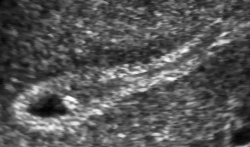 Many women feel
the effects of their own menstruation - but who has seen
a moving, menstruating uterus? Dr. Jason Birnholz and
Frances Kent of Highland Park, Illinois (USA), report in
Medical Imaging International (Jan-Feb 1996)
about their creating moving
images of a menstruating uterus using
ultrasonography (sample at left). Not only does this
investigation unveil the workings of a normal menstrual
flow, it can be used to pinpoint structural causes of
abnormal bleeding. One of these days I hope to
get a moving copy for museum visitors and this MUM site.
Hey, didn't you always want to see what's causing all
the fuss?
Many women feel
the effects of their own menstruation - but who has seen
a moving, menstruating uterus? Dr. Jason Birnholz and
Frances Kent of Highland Park, Illinois (USA), report in
Medical Imaging International (Jan-Feb 1996)
about their creating moving
images of a menstruating uterus using
ultrasonography (sample at left). Not only does this
investigation unveil the workings of a normal menstrual
flow, it can be used to pinpoint structural causes of
abnormal bleeding. One of these days I hope to
get a moving copy for museum visitors and this MUM site.
Hey, didn't you always want to see what's causing all
the fuss?
(The image is courtesy of Dr. Jason Birnholz)
MUM Makes the Sylvia Comic Strip
Rummaging through the museum this evening, and stumbling over Mack C. Padd, MUM's distinguished cat, I found the Sylvia comic strip from 5 August 1995 discussing this museum, which many people probably have not seen. A great lady from Los Angeles, now fighting cancer, clipped it out and sent it to me a year ago.

(Used with permission of Nicole Hollander)
Tampax Reaches Out
Tambrands e-mailed me last week,
suggesting I add their two links (Tampax & Troom) to the MUM site.
I just did! They are also in NetConnect.
More on Menstruation Exhibit in Norway
The SCA Mølnlycke company in Tønsberg, Norway, the
largest producer of menstrual pads and tampons in
Norway, created an exhibit about menstruation in their county museum (!) on the
occasion of the company's 50th anniversary. Lasse
Gjertsen faxed MUM that the company would send more
information about the exhibit in the next few weeks. In
the meantime, look at the Website of a
non-American manufacturer of menstruation products!
Instead Bent the Rules!
A securities analyst kindly sent me information about
Instead, the new menstrual cup (see
below), which indicates that the parent company
(Ultrafem) advertised that the total time a woman came
safely wear it as 12 hours, not the eight that
the Food and Drug Administration approved. And the
company altered the composition of the product after the
FDA approved it. It's not clear that either change will
harm the wearer, and I believe the FDA and Ultrafem are
discussing the changes. Ultrafem based its increased
length of usage on tests showing that the bacterial
count in the menstrual blood in the cup did not increase
when retained four more hours.
Another securities report calls holding shares in
Ultrafem "risky," because of doubts that enough women
will want to deal with the insertion and removal
process, leaking, as well as other reasons. Education is
the key, the report says, and I agree.
A similar product, Gynaeseal in Australia - it
even had (has?) an insertion device - failed recently
because of a "total lack of interest" on the part of the
Australian public and government. I thank Megan Hicks of
the Powerhouse Museum in Sydney, Australia, for this
information.
I work in a federal government office, and two weeks ago
I distributed six Instead cups to interested co-workers.
The one report I have so far gotten back is negative.
The tester simply didn't like the insertion and
withdrawal process.
But there may be enough interested women to make the
product viable.
Menstrual Cups May Do the Best Job - If Women Can Overcome Negative Attitudes!
As discussed earlier (see below for a
discussion of cups in general), Ultrafem just
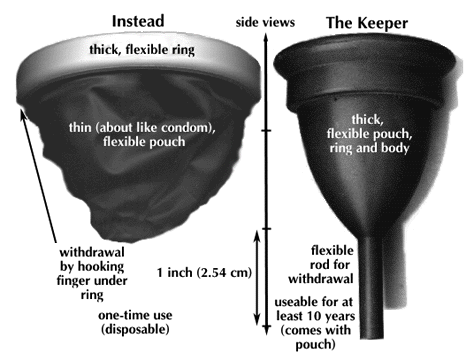
started marketing Instead (picture below) in the
western part of the U.S.A. (Or buy by telephone:
1-800-INSTEAD). It's a disposable
menstrual cup which costs less than 40 cents. Women have been able
to buy a re-usable cup since the 1980s, The Keeper
(see also MenstrualCentral)
(below), from a company in Ohio.
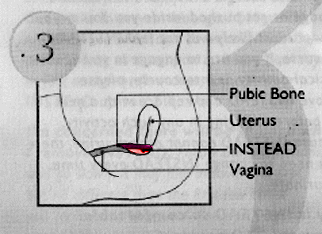 Where
Instead sits (from the Instead instructions, with
added color). Ring is dark red, pouch is lighter
color.
Where
Instead sits (from the Instead instructions, with
added color). Ring is dark red, pouch is lighter
color.
The Instead people say women can keep the cup in about twice
as long as they would a tampon, up to 12 hours
on light days. And users can wear the cup during sexual
intercourse for blood-free sex. As also mentioned below,
cups are probably the safest of all menstrual
protection devices.
But many women are reluctant to insert their fingers
into their vaginas, especially during menstruation, and
this may pose a problem for wide acceptance.
And there is the disposability factor - this is not
biodegradable material.
Finally, apart from the great merits of the product, I
must mention again that menstrual cups have been around
for decades (see the item below). The old Tassette and
Tassaway cups were advertised in mainstream, national
magazines like Bazaar, even if The Keeper is less widely
advertised (it deserves better). Advertising folks are
not telling the truth when they claim that - as Padette
also does in the next item down - Instead is the first
really new thing in menstrual protection in 60 years. See also my protest
below.
There is a recent New Yorker magazine cartoon showing
a line of public relations people in front of the door
to PR hell. Above the door a sign reads (approximately,
anyway), "Abandon All Hype, Ye Who Enter Here."
I wish.
Always Changing?
Speaking of claims to being new, I hope that everyone knows that all these "New!" exclamations plastered on pad and tampon boxes are usually hype at its worst. A Canadian observer of this Web site just sent me an article about Procter & Gamble, which reveals that they make over 200 versions of their Always pad, some differing by no more than a millimeter in length.
I think it's simply a shameless attempt to delude
women into thinking that, at last!, this thing will
work for me. Always is not the only offender.
Try the Interlabial Padette!
Recently a graduate student called me and told me
about the Padette (below), a wedge of material the user
places between the lips of her vulva, not into
the vagina (picture below).
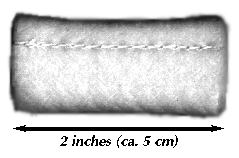
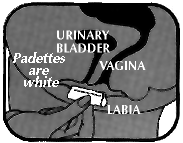
Women use them on light menstrual days, for light
urinary leakage or for other light secretions, and the
company - A-Fem Medical Corporation - says it has the
absorption capacity of a junior/regular tampon. The
manufacturer states that the pads stay put, without
adhesives, unlike the shifting usual pads, and they
don't bunch up. Padettes are made from the "same
materials commonly used in leading tampon products,
external pads and panty pads," without being highly or
super absorbent. They are changed with each urination,
and either flushed down the toilet or wrapped and thrown
into the trash.
If you live in Florida, find them in Walgreens drug
stores. Otherwise, order them by phone at 1-800-700-8716
(Pacific Standard Time 9-5). Ask questions at
1-800-764-6864 (EASTERN Standard Time 9-5). They cost
$7.05 for 48 (the minimum sold, in two boxes), which
includes shipping and handling.
I have two quibbles with the merchandising of
this probably good product:
-The actual name of the pad is Fresh 'n Fit Padettes.
Shouldn't there be an apostrophe after the "n," assuming
the word is "and"?
-And the company claims it's the "first major innovation
in feminine protection in over 60 years." Sixty years
ago was 1936, the year Tampax came out. But the first
commercial menstrual cup came out about 35 years ago,
and that was TRULY an innovation.
By the way, Instead, the menstrual cup which just
appeared, makes the same claim (see the two items, one
right above, the other several sections below).
MUM Looks for Additions
Do you have or know of items which belong in the
Museum of Menstruation? These can be articles, books,
ads, actual products (but unused!), packaging, pictures
or silly, kitschy things - and anecdotes or reports from
any culture. Actually ANYTHING concerning menstruation
in any culture, however humble, is a welcome addition to
the museum and archive.
Scholars and the public from around the world look to
the museum as a source for cultural information about
menstruation, and you can help them!
The museum is expanding its collection, and is seeking a
completely public place for its exhibits and archive -
and future cafe, shop and meeting and lecture halls.
Being considered also is a unique display of the history
of women's health, an expansion of the concept of the
museum.
NEXT earlier news - Next later news