|


|

The Museum of Menstruation and Women's
Health
Chichesters (or
Chi-ches-ters or with 's)
English Pennyroyal Diamond Brand
pills for menstruation problems
like pain, scanty or no menses
(amenorrhea, dysmenorrhea), and
probably abortion, 1890s-early
20th century, U.S.A.
Boxes,
pills, texts
"Relief for Women" booklet
The donor of these many items
writes:
Their [Chichester's] ads
helped start the federal
campaign about truth in
advertising etc. You
can see that not only in the ads
but the change on the tins.
The large
tins are the store display
that would have held 12 of the smaller
tins - all sealed with the
blue ribbon, which is why there
is a hole in the bottom of the
tins to secure the ribbon. . . .
Chichesters first pills were
called Chi-ches-ters Pennyroyal
Pills. It is argued that they
had to change the label because
they really did not have
pennyroyal [a plant] in them,
others argue they had both
pennyroyal and tansy, and were toxic.
Some deaths
were blamed on the early pills;
more recent deaths have been
said to be caused by people
using these herbs
The Nationl Library of Medicine
writes this at
http://www.nlm.nih.gov/medlineplus/druginfo/natural/patient-pennyroyal.html
The essential oil of
pennyroyal is considered toxic.
Death
has been reported after
consumption of small amounts. A
characteristic noted in most
cases of pennyroyal overdose is
a strong minty smell on the
patient's breath.
A possible role for
N-acetylcysteine (NAC) in the
management of pennyroyal
overdose has been suggested.
However, this application has
not been confirmed by animal or
human studies.
The essential oil of
pennyroyal may act as an emmenagogue
(menstrual flow stimulant) and
induce abortion.
However, it may do so at lethal
or near-lethal doses, making
this action unpredictable
and dangerous. Future
research to determine the safety
and efficacy of the less toxic
parts of the pennyroyal plant on
the menstrual cycle is needed
before a recommendation can be
made.
Harry
Finley created the images.
I thank
the retired teacher who
donated this material and the
scans of the ads!
|
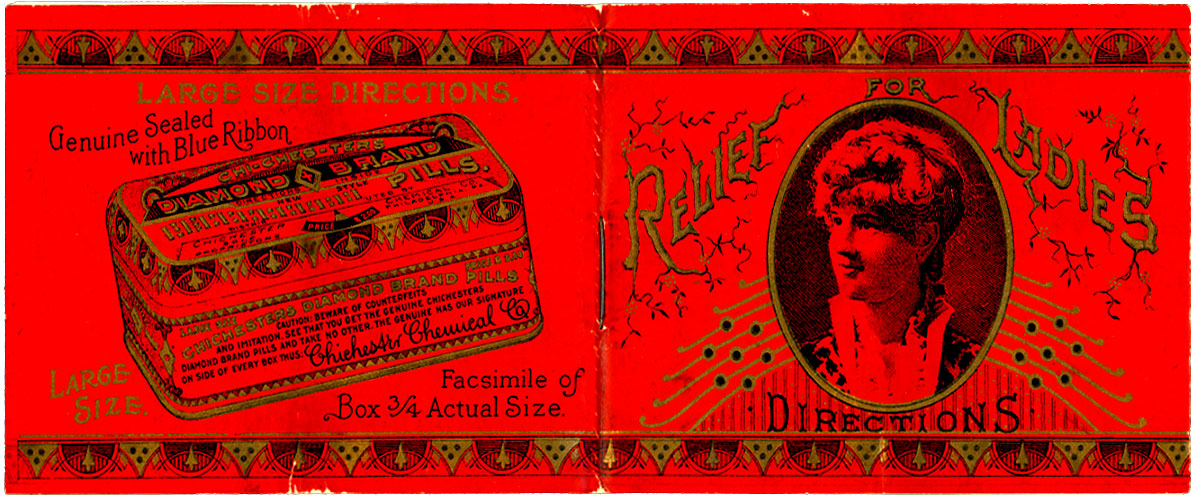
Below:
Back cover (left) and
front cover of a booklet
that came with the
donation. I can't say if
it was originally
associated with any of
the other items,
including the boxes
shown later.
Just
so you can savor the
color, typography and
text I enlarged
the covers more than the
other pages. The plant
design of the words
"Relief for Ladies," at
right, might reflect the
plant origin of
pennyroyal, but it's
bizarre, isn't it? Maybe
it mirrors the art
movement Art Nouveau,
flourishing in the late
19th-to-early 20th
centuries, which used
plant forms. Mixing many
type faces typified the
19th century (look at
some the published
scores of Beethoven's
music) - designers now
don't like it, mostly -
as did sinuous forms.
This describes the "new
style" pill made after
the company eliminated
the poisonous
pennyroyal.
|
|
 |
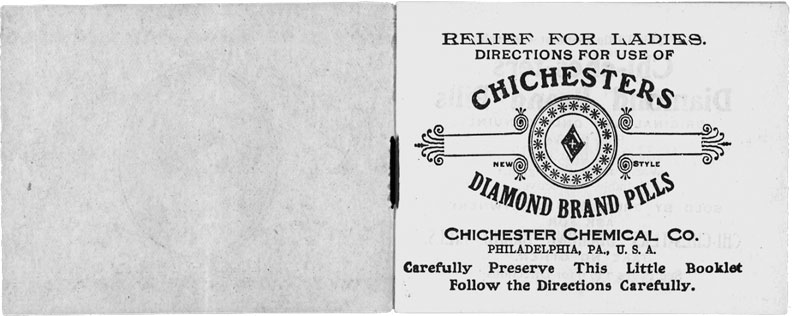
Below:
Inside front cover (left) and page
1. All inside pages are black and
white.
Each page (including of course the
covers, above) measures 3.25 x
2.5" (8.4 x 6.3 cm).
|
 |
© 2007 Harry Finley. It is illegal to
reproduce or distribute any of the work on
this Web site in any manner
or medium without written permission of the
author. Please report suspected violations
to hfinley@mum.org
|