SarahAnne
Hazlewood generously donated the
medicine to this museum (except the
Midol material), p
art of her gift of medical instruments,
books and advertising material about
women's health.
Harry
Finley created the images.
What did women do about menstruation in
the past?


|

MUSEUM OF MENSTRUATION AND WOMEN'S
HEALTH
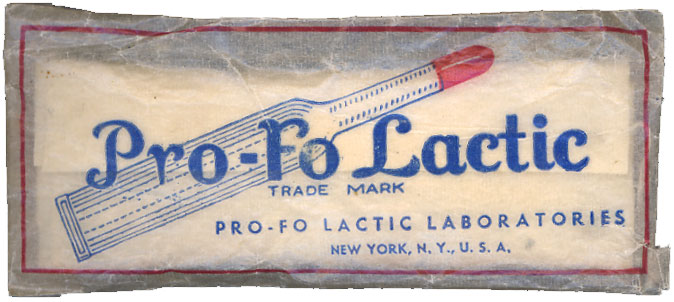
Pro-Fo Lactic (U.S.A., 1930-1940s?)
Prophylactic and/or treatment for sexually
transmitted diseases (syphilis & maybe
other STDs), or a contraceptive,
or both, for men and possibly women, with
sheath ("sanitary bag") & ointment
(medicine)
Well, I pulled a fast one on
you!
It seems that men used
Pro-Fo Lactic, not women. But one word
indicates to me that it was
possible women used it also. But
maybe not.
Anyway, it's bizarre
enough to satisfy any indecent
interest you might have so read
on.
SarahAnne
Hazlewood generously donated
this packet to this museum.
|
Below:
The glassine-like
bag measures 3 7/8 x 1
5/8" (9.6 x 4 cm). I could not
find
the trademark on the U.S. Patent
& Trademark Office Web site so
it's tough to date.
But it looks
as if it's from the 1930s-1940s.
|
 |
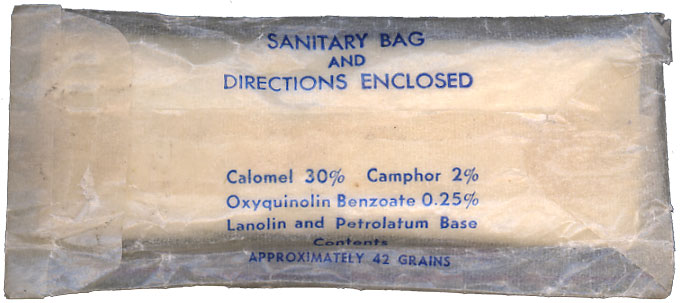
Below:
Wikipedia has this say about Calomel in the
ingredient list (my
emphasis throughout):
"Mercurous chloride [calomel]
is toxic,
although due to its low
solubility in water it is
generally less dangerous than
its mercuric chloride
counterpart. It was used in
medicine as a diuretic and
purgative (laxative),
e.g. from the early 1830s
through the 1860s as a purgative
in the U.S. These
medicinal uses were
discontinued.
"It has also found uses in
cosmetics as soaps and skin
lightening creams, but these
preparations are now illegal
to manufacture or import in many
countries including U.S.,
Canada, Japan and Europe. A
study of workers involved in the
production of these
preparations, showed that the
sodium salt of
2,3-dimercapto-1-propanesulfonic
acid (DMPS) was effective in
lowering the body burden of
mercury and in decreasing the
urinary mercury concentration to
normal levels.[5]
"It
was used in the treatment of
syphilis."
Wikipedia
on oxyquinoline:
"The complexes as well as the
heterocycle itself exhibit antiseptic,
disinfectant,
and pesticide
properties.[5][6] Its solution
in alcohol are used as liquid
bandages. It once was of
interest as an anti-cancer
drug.[7]"
And on camphor:
"It is also used in
medicine. Camphor is readily
absorbed through the skin and
produces a feeling of cooling
similar to that of menthol and
acts as slight
local anesthetic and
antimicrobial
substance. There are anti-itch
gel and cooling gels
with camphor as the active
ingredient. Camphor is an
active ingredient (along with
menthol) in vapor-steam
products, such as Vicks
VapoRub, and it is
effective as a cough
suppressant. It may also be
administered orally in small
quantities (50 mg) for minor
heart symptoms and fatigue. .
. .
"In 1980, the United States
Food and Drug Administration
set a limit
of 11% allowable
camphor in consumer products
and totally banned products
labeled as camphorated oil,
camphor oil, camphor liniment,
and camphorated liniment
(except "white camphor
essential oil" contains no
significant amount of
camphor)."
|
 |
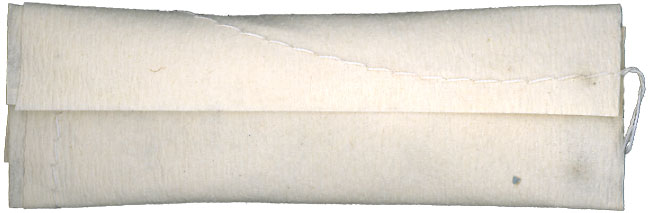
Below:
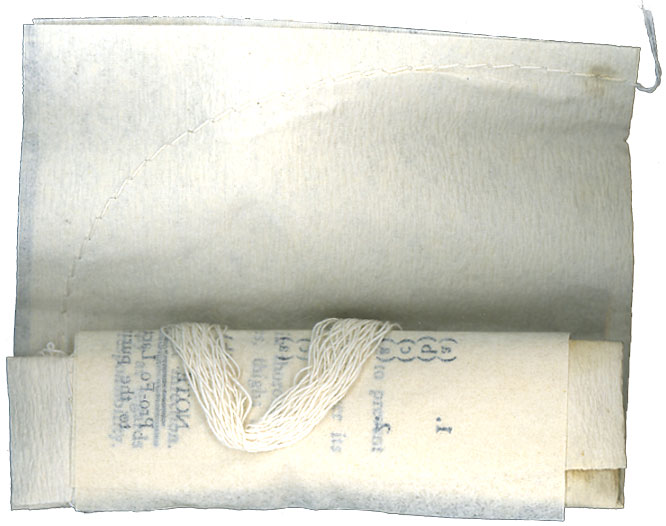
The contents of the bag - another bag
as it turns out.
|
 |
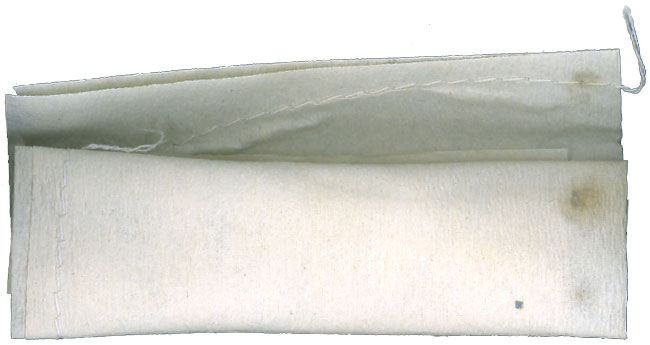
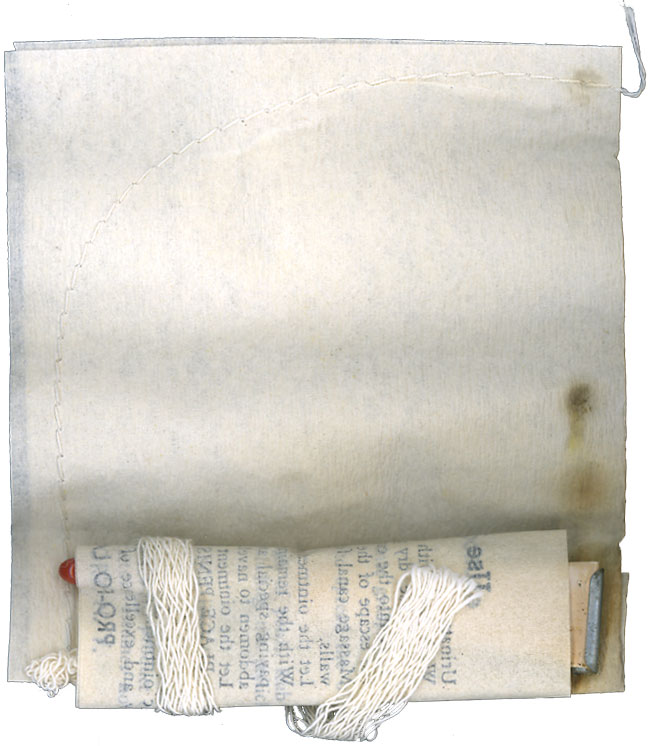
Below:
I fold open the bag.
|
 |
 |
 |
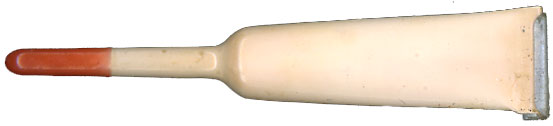
Below:
The tube of
ointment that peeked out
from the directions, above.
The tube is 3 1/16" (7.6 cm) long
and bears no
text.
|
 |
NEXT: Directions
& bag | Nice
Smyle More contraceptives
& information What did women do
about menstruation
in the past?
Boxes of patent
medicine for women
Murray & Nickell Blue Cohosh Root
| Murray &
Nickell Cotton Root Bark | Allaire Woodward &
Co. Oak Bark-White |
Wampole's Vaginal
Cones with Picric Acid | Humphreys "31" | Orange Blossom
Suppositories |
Dr. Pierce's Vaginal
Tablets | Micajah's
Medicated
Wafers | Santrex
Formula 52T | Sedets
|
Midol menstrual
pain relief tins
(containers), old ads, old booklet
© 2009 Harry Finley. It is illegal to
reproduce or distribute any of the work on
this Web site
in any manner or medium without written
permission of the author. Please report
suspected
violations to hfinley@mum.org\
|