See a
modern bowl, this one for soaking
used washable pads.
See menstrual
artifacts from
Almora, Uttar
Pradesh state, India; Rajasthan state, India;
19th-century Norway; Italy; and instructions for making Japanese and German washable pads from the late 19th and
early 20th centuries.
Read
about the washable pad project for the
neighboring Indian state, Rajasthan.


|
Museum of Menstruation and Women's Health
Ancient art:
Pre-Columbian bowl from
the Nasca culture on the
coast of Perú, c. 200
BCE - 600 AD, showing a
menstruating vagina
A remarkably explicit
exhibit at the National
Museum of Women in the
Arts, here in
Washington, D.C., showed
an earthenware
bowl
enclosing images of
menstrual blood
(drawings, below) and
what appear to be
pubic hair and either
a clitoris or the
remnants of the hymen.
The pubic hair occupies
a raised portion,
probably indicating the
mons pubis.
Other objects in the
show, called Divine
and Human: Women in
Ancient Mexico and
Peru, included
more images of the vulva
than you'd find in
several months of
Playboy. And Playboy
would never publish
anything like the Kama
Sutra-like sculpture of
couples, um, going at it
in every which way, if
you get my drift. A
Washington Post review
hinted that men
created most of the
sculpture, which
figures, but to what
end? A sign
warns mommies that
they might not want
their kids to see
these clinical works.
But after the numerous
visiting children took
in the genitalia
scattered about - all
female except for those
of half the copulating
figures - it was but a
baby step to see one of
the things women used
them for. Hm, maybe that
was an adult
step.
The ladies at the
information desk stopped
me from using my
camera to
illustrate the bowl for
MUM but encouraged me to
draw
it, so I
trotted to a Utrecht art
store a block away and
returned with
Prismacolor pencils and
paper. Although it
wasn't easy drawing in
semi-darkness and
standing up - any
sacrifice for my MUM
visitors, which included
a $6 entrance fee and
vegan lunch with
non-vegan chocolate
mousse! - the drawings,
below, give a good idea
of what some of our
ancestors employed to
hold - well, what? Peanuts?
The catalog doesn't say.
Could
it have caught menses
for some ritual?
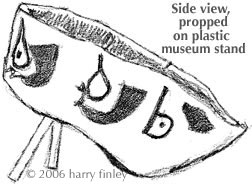
Neither does the
catalog explain the images
in brown on the
sides.
(A boy about 10
watched me draw the bowl
and afterwards asked me
if I was an artist (I am).
An hour later I saw him
and his mother and
brother in the same
store I had bought the
pencils and paper, where
I was standing at the
cash register with
Arches 300-pound
watercolor paper for a
double portrait I took a
commission to do. The
boy's mother was buying
him Prismacolor pencils
and paper.)
One museum sign
reported that these
early Americans called
childbirth - depicted in
the exhibit in three
dimensions many times -
"the
time
of death," I
assume a reference to
the horrors sometimes
awaiting mother and
child. One argument
against Intelligent
Design, by the
way, would be that an
Intelligent Designer
would make childbirth
easy, not hard, even
fatal.
And in a detailed
story of a sacrifice
winding around a large
bowl, I saw what must be
the ur-Saul
Steinberg dog
in profile, the pooch
that delighted readers
years ago in the New
Yorker magazine
(and in an exhibit at
the Smithsonian's Museum
of American Art). I
laughed until I realized
that the Steinberg dog
often made me shiver
then as it did here,
where it accompanied
ghastly acts.
The exhibit closed
28 May 2006.
|
A MUM
visitor kindly e-mailed more
information (Sept. 2009):
I inter library loaned this
book [below].
Amazon listing [and see Google
books on line] with more info:
<http://www.amazon.com/Sex-Pots-Eroticism-Paul-Mathieu/dp/0713658045/ref=sr_1_2?ie
=UTF8&s=books&qid=1252301706&sr=8-2>
The picture [a photo,
which I was not allowed to take
in the museum] is on page 38 and
on page 39 it reads
"The Museo de la Nacion in
Lima holds an exquisite, small
Nazca bowl with curved sides,
painted all around with graphic
vaginas, and another powerfully
graphic Nazca bowl, with folded
sides like vaginal lips, has in
its interior space moulded in
relief in the raised shape of
the 'Venus mount,' inscribed
with stylised pubic hair and
showing the mentrual flow in
red, oozing toward the lip of
the bowl, possibly implying,
here again, some pouring or even
drinking ritual."
It is referring back to the
previous page where the author
refutes the interpretations of
these sculptures as purely
humorous and states a belief
that they involved some sort of
inebriation rituals, since many
of the sculptures were also
vessels and that their
pour/spout was always the
urethra, vagina or anus, so that
the user was ritualistically
taking in the fluids and/or
vicariously engaging in some
form of oral sex.
|
|
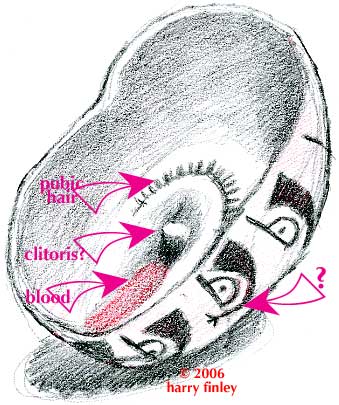
The
bowl's greatest
dimension is about 4.75"
(c. 11.4 cm) but was
hard to measure from
outside its glass
cabinet; I eyeballed it
with a ruler because the
catalog gave no sizes.
The Banco Céntral de
Reserva del Perú owns
it; the stockholders
would revolt if Wachovia
owned such a thing.
Brown, red - ! - and
cream color it, which I
left out of the drawings
below to speed the
download. The menstrual
blood pools out of sight
to the right. I was not
allowed to photograph
the object but the
museum docents
encouraged me to draw it
(I'm an artist).
The shadow under the
"clitoris" is just that,
not a depression that
might form the entrance
to the vagina.
|
|
|
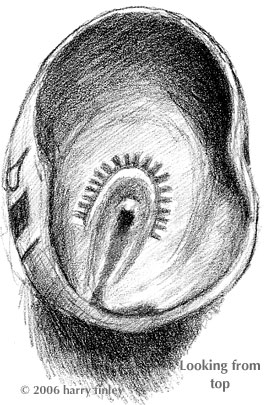
I dropped
the color from the
drawings above and below
to speed up download.
The menstrual blood in
the cup is red as shown
in the first drawing.
|
 |
The
drawings are copyright
2006 Harry Finley.
See a modern
bowl, this one for
soaking used washable
pads.
Next
artist of
menstruation: Mayra
Alpízar
|
See menstrual artifacts from Almora, Uttar
Pradesh state, India; Rajasthan
state, India; 19th-century Norway; Italy;
and instructions
for
making Japanese and German
washable pads from the late
19th and early 20th centuries.
© 2006 Harry
Finley. It is illegal to reproduce
or distribute any of the work on
this Web site in any manner or
medium without written permission
of the author. Please report
suspected violations to hfinley@mum.org
|
|