o.b. ads,
booklets & actual tampons: German (1970s) - German (1972) nude
woman on bed - German
nude (1970s) - French
(1989) - folder,
Germany, early 1950s (tells
what o.b. means!) - Dutch, two ads from
1959 giving THEIR take on what o.b. means,
which was wrong - Dutch ads, 1962, 1967 - Belgian ad with
beach & bathing suits, 1980s? - American
ad showing Judith
Esser, designer of the o.b. tampon,
August, 1984 - o.b. puberty
booklets (excerpts): German, Dutch (2004) -
o.b. actual tampons:
Switzerland (o.b.é.),
1970
More o.b. booklets:
[Die] Menstruation (excerpts, 1977,
o.b. tampons, Germany) Photographer David
Hamilton contributed many photographs to
this explicit and beautiful booklet. By the
way, "Die" in the title means "the," not to
lose life.
Volwassen worden
("Growing up," the Netherlands, excerpts, 2004,
o.b. tampons)
Your Personal Guide to
Menstruation and Tampon Usage (complete booklet,
U.S.A., 1988, o.b. tampons)
Booklets
menstrual hygiene companies made for girls,
women and teachers - patent
medicine - a list
of books and articles about menstruation
See early tampons
and a list of tampons
on this site - at least the ones I've
cataloged.


|
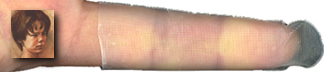
Anne
non-applicator menstrual
tampons with finger cots, box of 10
(1968)
Japan, from o.b. tampons
In honor
of ANNE FRANK (with a
caveat, below)
"Anne" is another example of the
Japanese use of Western words
and names. But in this case
the name is of a very particular
person: Anne
Frank of diary fame who
died in a Nazi concentration camp.
Read the amazing
story of the tampon (and
more extensively from my Dutch
translation). And read a Dutch
discussion (in Dutch) of
this Japanese menstruation-name
connection as related to a
menstrual pad (Anne Frank was born
in Frankfurt, Germany). I thank
very much the Dutch contributor of
many items to this site for
pointing out the tampon's name
origin!
This Dutch
father of four grown daughters also writes,
[Anne Frank] knows the
difference between tampons and
sanitary napkins when
she writes:
"Oh I forgot to mention the
important news that I'm
probably going to get my
period soon. I can tell
because I keep finding a
whitish smear in my panties
and Mom predicted it would
start soon. I can hardly wait.
It's such a momentous event.
Too bad I can't use sanitary
napkins but you can't get them
anymore, and Mama's tampons
can be used only by women
who've had a baby." (from The
Dairy
of a Young Girl - the
Definitive Edition).
NB: Quite interesting when you
read the Dutch text (from the
Dutch definitive Edition, 6th
edition, April 2001):
"PS. Ik heb je nog vergeten
het gewichtige nieuws te
vertellen dat ik
waarschijnlijk gauw ongesteld
wordt. Dat merk ik omdat er
steeds zo'n soort kleverig
zaad in mijn broek ligt en
moeder heeft het mij
voorspeld. Ik kan het haast
niet afwachten het lijkt me zo
gewichtig, alleen jammer dat
ik nu geen damesverband kan
dragen want dat krijgt men ook
niet meer, en die stokjes van
mama kunnen alleen vrouwen
dragen die al eens een kind
gehad hebben. "
I find it interesting that the
translation smooths the Dutch
text when:
a) 'soort kleverig zaad' becomes
"whitish smear" and
b) 'die stokjes' becomes
"tampons".
Zaad means literally in Dutch
'semen'
or 'seed'
and 'stokjes' means literally 'little
branches'. The
translation is very correct but Anne does
not use in 1942 the Dutch
words 'afscheiding'
(discharge) and 'tampon' we
nowadays are used to. [But the word
tampon DID appear in
Dutch advertising for Tampax
by at least 1938. See the third
paragraph of the small text
beginning with "Doctoren."]
Probably at the same time and
from the same company a menstrual pad
bore Anne (Frank's) name as
a Japanese student relates
and here.
CAVEAT:
On a jarring note:
ane
in Japanese means "elder
sister," usually
the first one to menstruate.
Could the company have had
this in mind? Does it
conflict with the Anne Frank
story?
But Ms.
Frank's was not the only
Anne-like name to grace a
menstrual product. An
American manufacturer named his
menstrual sponge after his wife
Anna! What is it with Ann(e,
a)? These are the only two
products that I know that bear the
names of real people although Ms.
Frank lent hers unwittingly.
Curious too is that both people were
Jews, who formed a very
small percentage of the
population. And the sponge
probably comes from the 1940s,
when Ms. Frank wrote her diary and
died. Write
me if you know of other
examples.
Note that these people - and ME,
the MUM director - are all outsiders
in society in some way: as Jews or
as males.
The Japanese regard non-Japanese
as very much outsiders when they
appear on their islands.
In Japan, apparently the
traditional method to absorb
menstrual flow was the pony, or
pad held by a belt.
Commercial menstrual tampons
were probably a mid-20th century
introduction.
One of the reasons Western women
used tampons even before their
commercial introduction in the
1930s was for performing
in front of an audience. But
in Japan men
played the female parts in
traditional theater, thus
eliminating any worry about
menstruation.
Elldy,
also Japanese, also had finger
protectors (cots).
This tampon is an o.b. adapted
for Japan.
Read
about Japanese
script on tampon boxes.
I thank
the former Tambrands (history) for the
donation!
|
Below:
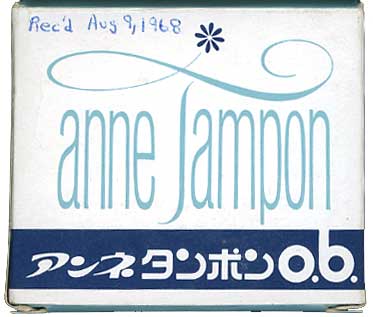
The cardboard
box measures 2
1/2 x 2 1/8 x 1 1/8" (6.4
x 5.4 x 3 cm).
Someone at Tambrands,
the former maker of
Tampax, wrote "rec'd
[received]" and the date
on the box.
|
Below:
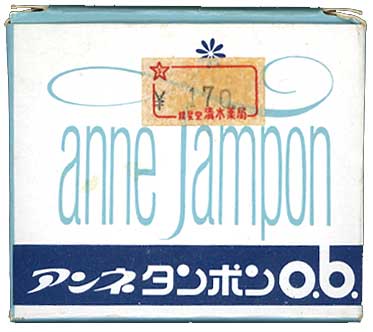
The opposite
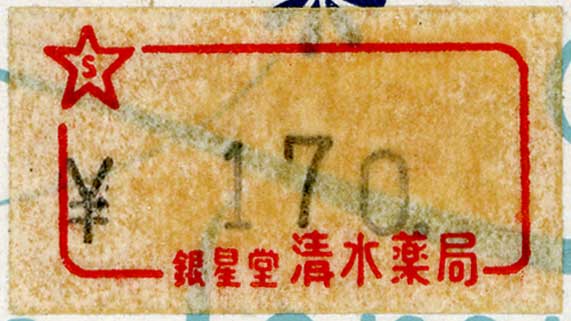
side of the box. The price
label, for 170 yen, lies
enlarged below. This is
almost the same price as
for a contemporary
Japanese tampon, Cellopon.
|
 |
 |
|
Below:
For those wishing to brush up on
their Japanese. Good luck!
|
 |
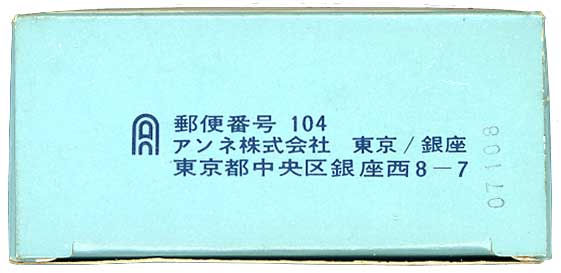
Below:
The bottom
of the box.
|
 |
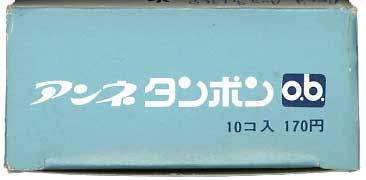
Below:
The top
of the box.
|
 |
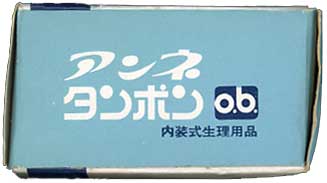
Below:
The small
sides of the box are identical.
|
 |
NEXT |
instructions p.1
& p.2
- tampon
o.b. ads,
booklets & actual tampons: German
(1970s) - German
(1972) nude woman on bed - German nude
(1970s) - French
(1989) - folder,
Germany, early 1950s (tells what o.b.
means!) - Dutch,
two ads from 1959 giving THEIR take on
what o.b. means, which was wrong - [Die]
Menstruation (excerpts,
1977, o.b. tampons, Germany)
Photographer David Hamilton
contributed many photographs to
this explicit and beautiful
booklet.
So many BOOKLETS
- So many TAMPONS
|
|
© 2010, 2016 Harry Finley. It is illegal
to reproduce or distribute any of the work
on this Web site in any manner or medium
without written permission of the author.
Please report suspected violations to hfinley@mum.org
|