See some Kotex first-campaign ads: general discussion and
ad prototype - January
1921 - May 1921
- November
1921
See more Kotex items: First ad
(1921) - ad 1928 (Sears
and
Roebuck catalog) - Marjorie May's Twelfth
Birthday (booklet for girls, 1928,
Australian edition; there are many links
here to Kotex items) - 1920s booklet in
Spanish showing disposal
method - box
from about 1969 - Preparing
for
Womanhood (1920s, booklet for girls)
- "Are you in the
know?" ads (Kotex) (1949)(1953)(1964)(booklet, 1956) -
See more ads on the Ads
for Teenagers main page


|

Newspaper ads for
Kotex menstrual pads, 1920s
(U.S.A.)
Nurse
Buckland lived! Nurse Maxfield
lived, probably. But Mary
Pauline Callender? Apparently,
yes.
(Ads with
Jean Maxfield and newspaper
notices and more ads with Ellen
Buckland are
here.)
In the 1920s and 30s three women
often appeared in Kotex ads: Ellen
J. Buckland, G.N. (graduate nurse)
and Jean Maxfield, G.N., below,
and Mary Pauline Callender, the
author of the Marjorie May series
of booklets for Kotex (example).
She's mentioned as a real person
in an ad entitled H.
C. Capwell's.
A genealogy researcher who has
generously contributed many ads
and information to this site
investigated both women. She
writes,
I started looking for Ellen
Buckland and I find her working
as a nurse in 1920 at Children's
Memorial Hospital, on Fullerton
Ave. in Chicago, Illinois. She
is 39 in 1920, from Appleton,
Wisconsin, single, and her
parents are Comfort S. (born in
Ohio, served in the Union army
in the Civil War) and Katherine
L. Buckland (New York). She has
a sister, Lucy Reeve, who is
widowed, and a nephew in
Wisconsin named John P. Reeve
and a niece Theodora Reeve. In
1930, she is back living at 850
Prospect Street in Appleton,
Wisconsin, and she is still a
nurse working for a paper mill.
So, that mill is probably one of
Kimberly-Clark's paper mills. .
. .
Here is another Kotex nurse in
an ad [Jean Maxfield]. The most
interesting thing is she is
supposedly an assistant to the
invisible, never
making-a-public-appearance
society lady, Mary Pauline
Callender [alleged author of
the Marjorie
May series of pamphlets for pubescent
girls]. One problem is
this is Jean Maxfield's married
name so she got married between
1930-1935, which means I don't
know her maiden name and records
are limited after 1930. I think
her husband is Lorin Maxfield
(b. 1915) but I am not positive;
I found a public record from
2002 that indicates he was still
living then but she died 1992 in
California. Also, these
are the only two ads about her,
1935 and 1938, but the second ad
does not refer to Mary
Callender, in fact it doesn't
even call MRS. Maxfield a nurse
any longer. Hmm? . . .
The following made me wonder if
1926 is when Kotex went from
real women (like Buckland and Lee Miller,
the first real woman in a Kotex
ad) to fictional characters like
Callender, plus I wonder who was
doing the ads before him
[Wallace Meyer; I named the chair my
oldest cat occupies after
him] [the following comes from
toiletpaperworld.com - no,
that's right]:
[Ad man Albert] Lasker landed
the account (Kotex) in 1926.
Lasker's pitch combined a
campaign to inform school
boards and other organizations
nation-wide about Kotex, and
how teachers could perform a
valuable service by telling
female students about feminine
hygiene. Then he convinced the
editors of Ladies Home Journal
to publish an article about
menstruation. Finally he
devised a way for women to buy
the product without
embarrassment. Newspaper ads
told them that "Kotex", in a
wrapped package that gave no
clue as to its identity, would
be available in shops and did
not even have to be asked for
by name. The customer could
put 50 cents in a box near a
pile of packages, take one,
and walk out.
More evidence he probably
invented Callender:
When Lasker discovered
Palmolive the soap was an
"also ran" product. Lasker saw
opportunity in the green color
and palm/olive oil contents.
Lasker took the Palmolive
account and insisted that all
Palmolive advertising be
focused around the idea of
beauty, not cleansing. This was
the beginning of the shift
from information to
storytelling in advertising.
Lasker joined
Palmolive's excellent "beauty
story" with a coupon program
which allowed customers to
obtain a sample of the
product. Within three years
time Palmolive was the world's
number one selling
soap (from Mattmanna.com)
[Read more about Lasker
here, bottom of page.]
But her search for the likely
Ms. Callender failed. Does
anyone out there have any information
about her? She is
mentioned in an ad for H.
C. Capwell's so I think
she existed.
Read the
commentary between the two ads.
I again thank the industrious
and generous genealogy researcher
for these ads!
|
Ads with Jean
Maxfield and newspaper
notices and more ads with Ellen
Buckland are here.
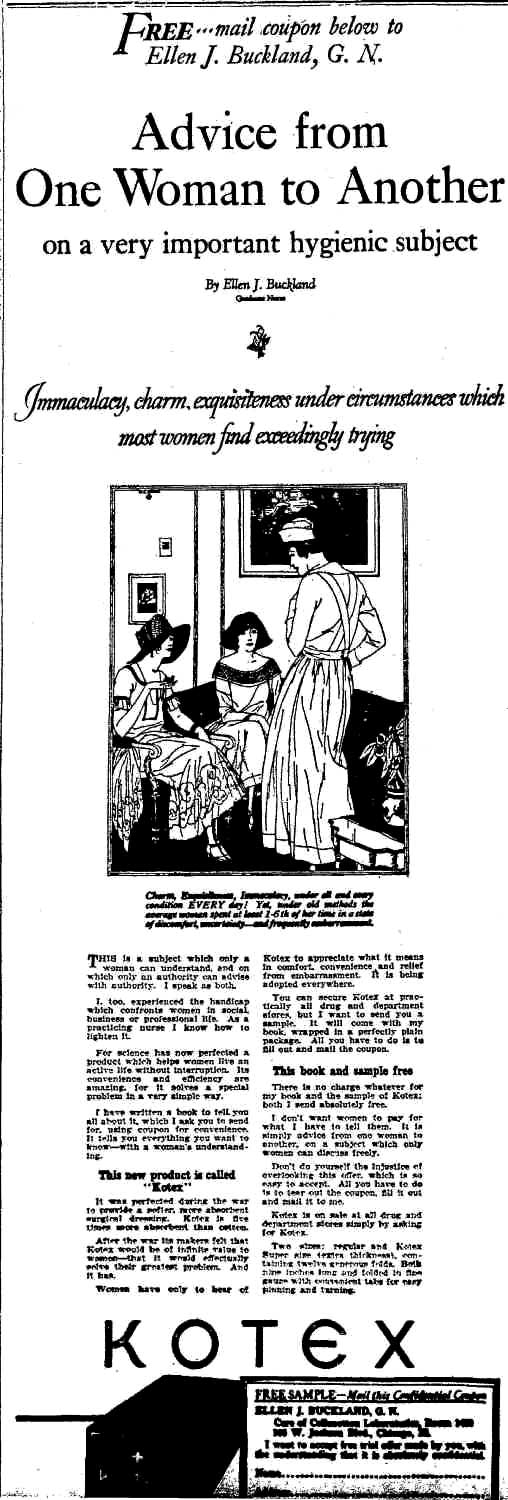 |
Above:
from the Syracuse [New York]
Herald, November 25, 1923. The
center woman could step out of an
Aubrey Beardsley drawing,
England's greatest artist (just my
opinion). Isn't the drawing great?
And everyone looks so formal - and
rich (except the nurse). (See a
crude Beardsleyesque drawing in a
Japanese ad
for menstrual pad belts from the
early 20th century.) But rich was
a theme in many early Kotex ads,
as in this beautiful
one from 1923 - and read the
third line
in the ad below.
Talk about the war and nurses
refers of course to how nurses in
World War I used Kimberly-Clark
bandages as menstrual pads. The first ad
says this better.
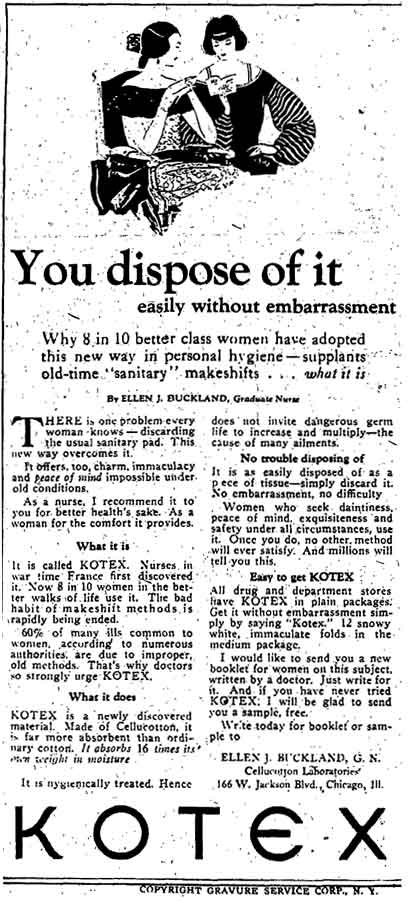
Below:
from the Indianapolis [Indiana]
Daily Star, July 13, 1924. The
woman at right looks like the
actress Louise
Brooks, a B actress at the
time of the ad but in four years
she would make two silent films
("Diary of a Schoolgirl" and
"Pandora's Box") that would cause
the French to name her one of the
two greatest actresses of all time
(the other one being Maria
Falconetti, in "Joan of Arc.")
Those French! Alright, back to
menstruation.
This ad offers a booklet- read
under "Easy to get KOTEX" - which
might have been similar to this Kotex booklet
from 1933.
And "old-time 'sanitary'
makeshifts" means washable
pads, the way probably most
women absorbed their menstrual
discharge in the 19th century and
before - IF
they used anything at all.
|
 |
CONTINUED: Ads
with Jean Maxfield and newspaper notices
and more ads with Ellen Buckland are here.
See some Kotex first-campaign ads:
general discussion
and ad prototype - January
1921 -
May 1921 - November 1921
- See more newspaper
ads for Kotex and other items
© 2006 Harry Finley. It is illegal to
reproduce or distribute any
of the work on this Web site in any manner
or medium without
written permission of the author. Please
report suspected violations to hfinley@mum.org
|