Kotex ad emphasizing shame,
1992
See Kotex items: First ad (1921) -
ad 1928 (Sears and
Roebuck catalog) - Lee
Miller ads (first real person in a
menstrual hygiene ad, 1928) - Marjorie May's Twelfth
Birthday (booklet for girls, 1928,
Australian edition; there are many links here to
Kotex items) - Preparing
for Womanhood (1920s, booklet for girls;
Australian edition) - 1920s booklet in Spanish
showing disposal
method - box
from about 1969 - "Are
you in the know?" ads (Kotex) (1949)(1953)(1964)(booklet, 1956) - See
more ads on the Ads for
Teenagers main page


|
Lister's Towels disposable menstrual napkin
(ads)
The first American
disposable? (1896-1920s?)
Until about the 1880s women in
America and Europe probably either
made their own menstrual pads (see Norwegian
pads), bought washable pads (here) or
wore, um, nothing (read about
this).
But then Hartmann
in Germany and Johnson & Johnson
in the U.S. made throw-away pads,
similar to what women use today in
many countries.
The Dutch contributor of many
items and information to this site
writes that in the book Dieses
kleine Stück Watte: Werbung und
Tabu, am Beispiel Binden und
Tampons (Renate Waschek,
1995) [This Little Piece of
Wadding: Advertising and Taboo
Using the Examples of Menstrual
Pads and Tampons - Harry
Finley made all the translations]
"[s]he has a timetable with
important dates (starts on page
115). She writes:
1885: Fürst beschreibt erstmals
den Aufbau einer
Menstruationsbinde," etc. etc.,
with reference to Hering; Maierhof
page 36-37 [Fürst
describes for the first time the
construction of a menstrual pad.
(It's possibly here,
published in 1894.)] [See an 1888 design
by German gynecologist J.
Großmann.]
1896: Die ersten industriell
gefertigten Wegwerfbinden kamen in
den USA auf den Markt. Sie
bestanden aus Wattekissen im
Mulleinschlag und wurden von der
Firma Johnson &Johnson
hergestelt, Markenname: 'Lister's
towels.'" [1896:
The first American commercial
disposable pads appeared on the
market. They were made of a
cotton pad in a muslin case and
made by Johnson & Johnson
and called Lister's Towels.]
Her reference: page 299 of Umbach,
Wilfried (Hrsg.): Kosmetik.
Entwicklung, Herstellung und
Anwendung kosmetischer Mittel.
[Cosmetics: Development,
Manufacture and Use of Cosmetic
Materials] Kap. 6: Hygienemittel;
1988
Ende des 19. Jahrh. (...) Die
Verbandstoffirma Paul Hartmann
stellt für die Europäerinnen die
ersten Wegwerfbinden her - die
'Mulpa-Damenbinde.'" [End of the 19th
century . . . . The bandage firm
Paul Hartmann made the first
disposable pad for European
women - the 'Mulpa
Ladies Pad.'] She
didn't give a reference for this.
J&J's contribution was Lister's
Towels, apparently a product of the
"tiny Lister Company, whose principal
reputation was as a notorious price
cutter. Johnson bought it out for
$2,000," writes A Company That
Cares, the company history of
Johnson & Johnson, p. 52. The
company probably took its name from
the British proponent of germ theory
and cleanliness, who worked to reduce
the morbidity and death rate among
patients by killing germs using a
spray of carbolic acid.
The Curse: A Cultural History of
Menstruation (Delaney, Lupton
and Toth, 1988, pp. 138-39) states
Johnson and Johnson manufactured
"Lister's Towels" in 1896, the first
commercial disposable pad, made of
gauze-covered cotton. But because
turn-of-the-century morality
prevented advertising these
"unmentionables," the pads did not
reach many women and were eventually
withdrawn from the market.
But I think
they did reach many women and the
pads survived much longer than the
turn of the century as the ads below
attest.
And at least one other disposable
appeared in America before Kotex
muscled in in the early 1920s: Curads, now
mostly known for its bandages (that
term has been also used for menstrual
pads) - see an ad in
Vogue magazine.
I again thank the kind genealogy
researcher who found this valuable
evidence, below!
|
Below:
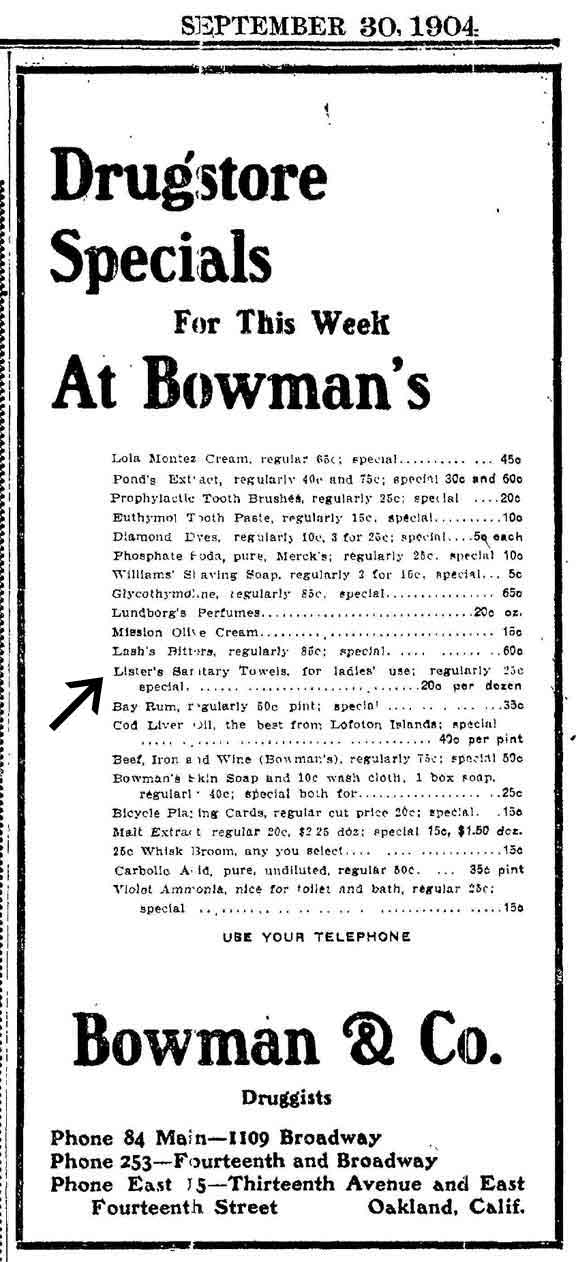
From the Oakland Tribune, September
30, 1904 (see
the arrow). Lister's is the
only menstrual pad listed!
|
 |
Below:
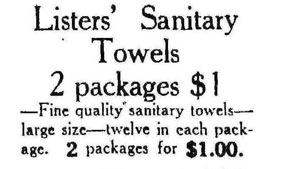
November 21, 1921, Oakland
[California] Tribune. Look how the
regular price doubled
from 1904 to 1921, same newspaper,
above, but without inflation figured
in. Hey, typo!
The apostrophe should be between the
r and s in the title!
|
 |
Below:
June 8, 1922, Reno [Nevada] Evening
Gazette. Look at the bandeau ad
below the Lister's; they were fabric
bands without cups that compressed the
breasts. Sized cups appeared in the
1930s. Flat or minimal breasts were
the rage then, as in John Held's
College Girl painting, here. Typo again, or dirt?
|
 |
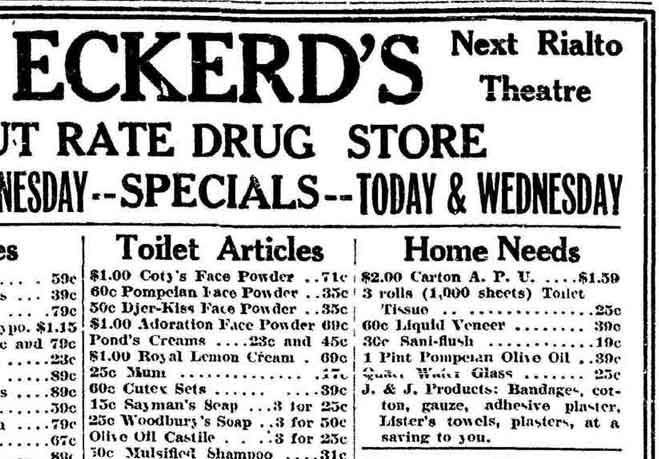
Below:
Lima [Ohio] News, May 1, 1924. See
Lister's Towels at the bottom of the
right-hand column. Wait, what's THAT?
Mum deodorant - no relation to your
MUM, this museum - is under Toilet
Articles. See an
ad for the real thing!
|
 |
Early American pads
in newspaper ads. Early Modess
pads in newspaper ads. First Kotex ad
(1921) -
Kotex ad 1928 (Sears and
Roebuck catalog) - Lee
Miller Kotex ads (first real person in a
menstrual hygiene ad, 1928)
See ads
for menarche-education booklets: Marjorie
May's Twelfth Birthday (Kotex,
1933), Tampax
tampons (1970, with Susan Dey), Personal Products
(1955, with Carol Lynley), and German
o.b. tampons
(lower ad, 1981)
See also the booklets
How shall I
tell my daughter? (Modess,
various dates), Growing
up and liking it (Modess,
various dates), and Marjorie May's
Twelfth Birthday (Kotex, 1928).
And read Lynn Peril's series
about these and similar booklets!
See another ad
for As One Girl to Another (1942), and
the booklet
itself.
© 2006 Harry Finley. It is illegal
to reproduce or distribute any of the
work on this Web site in any manner or
medium without written permission of
the author. Please report suspected
violations to hfinley@mum.org
|
|