Read some of the ethnic jokes that appeared in this and the
May issue from 1936.
Read a Personal Products booklet for older
girls from about this time, The Periodic Cycle
(1938). See similar
booklets on this site.
See a Kotex ad
advertising a Marjorie May booklet.
See many more similar booklets.
See ads for
menarche-education booklets: Marjorie May's Twelfth
Birthday (Kotex, 1932), Tampax
tampons (1970, with Susan Dey), Personal Products
(1955, with Carol Lynley), and German o.b. tampons (lower
ad, 1981)
And read Lynn Peril's series
about these and similar booklets!
Read the full text of the 1935 Canadian edition
of Marjorie May's Twelfth Birthday, probably
identical to the American edition.
More ads for teens (see also introductory page for
teenage advertising): Are
you in the know?
(Kotex napkins and Quest napkin powder, 1948,
U.S.A.), Are
you in the know?
(Kotex napkins and belts, 1949, U.S.A.)Are you in the know? (Kotex napkins, 1953, U.S.A.),
Are you in the know? (Kotex napkins and belts,
1964, U.S.A.), Freedom
(1990, Germany), Kotex (1992, U.S.A.), Pursettes (1974, U.S.A.), Pursettes (1974, U.S.A.), Saba (1975, Denmark)
See early tampons
and a list of tampon
on this site - at least the ones I've cataloged.


|

The Museum of Menstruation and Women's
Health
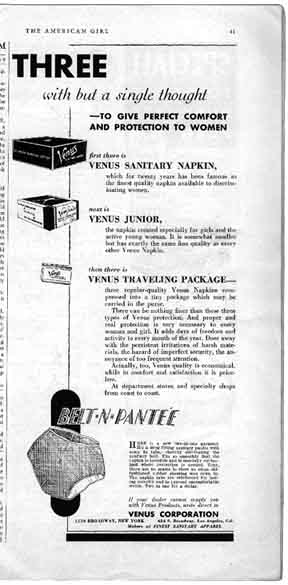
Venus menstrual pads and panties ad, 1936
The Venus Corporation advertised its
pads (see another ad and see a
pad and box)
and underpants in The American Girl
magazine (published by the Girl Scouts
of America), June 1936.
Words from Greek and Roman times,
like Venus, used to appear much more
often on products, reflecting a
greater familiarity with them. Kids
actually took Latin and Greek in high
school, which is rare today. Two of
the earliest ads for menstrual belts
in the Sears catalog bore the names
Diana, goddess of the hunt, moon, and
virgins; and Venus, goddess of love.
It seems a tad bold for the company
to advertise in the official Girl
Scout magazine. But kids are always
one step ahead of you, anyway.
I can't resist
it: read some of the ethnic jokes that appeared in
this and the May issue from 1936.
See the underpants &
panties directory.
|
|
|
|
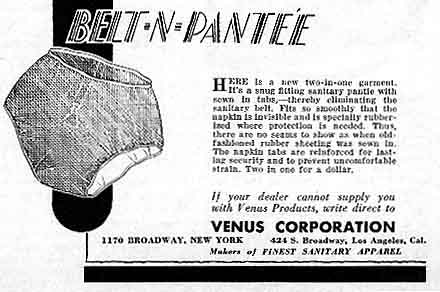
The Belt-N-Pantee
appears enlarged below.
|
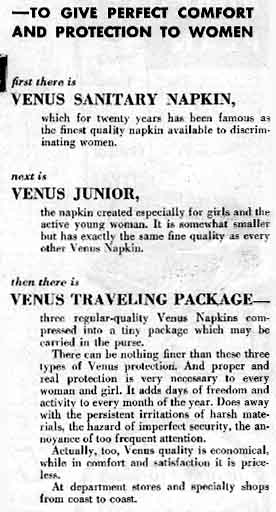
The small words
from the ad at left appear enlarged
above.
|
|
|
Tight-fitting
women's underpants - briefs &
panties, above - probably came into
general use about this time (1936), at
least by the evidence of the Sears, Roebuck
catalog. Up to then women wore
long, loose-fitting "boxer" type
underpants for everyday wear, although
for menstrual purposes "sanitary panties"
go back to at least the early 1920s
(apparently originally for over-night
use), and look like babies' diaper
underpants from the early decades of
the twentieth century (also sold
through the Sears catalog).
Women and babies both
involuntarily produce secretions, to
put it politely, and tight-fitting
underpants hold absorbent material
against the body. Belts by
themselves couldn't do a good job of
keeping a pad in place, especially at
night. Commercial
tampons didn't appear until the
early 1930s and faced many barriers to
acceptance.
The women on the 1912
British Olympic swimming team in
Stockholm wore tight-fitting trunks
under a nearly full-body covering, so
the concept was alive at least by
then.
I have read that
underpants were most recently
developed in the early 19th century,
in England, when girls were asked to
become more athletic in schools. The
underpants shielded their genitals
from view. The idea then spread to
France.
A visitor to this
museum reasonably suggested that the
available fabrics determined what kind
of underpants, or any clothing, could
be developed at any given time.
|
I can't resist it: read
some of the ethnic
jokes that appeared
in this and the May issue from 1936.
Underpants &
panties directory
© 1999 Harry Finley. It is illegal to
reproduce or distribute any of the work on this
Web site in any manner or
medium without written permission of the author.
Please report suspected violations to hfinley@mum.org
|